
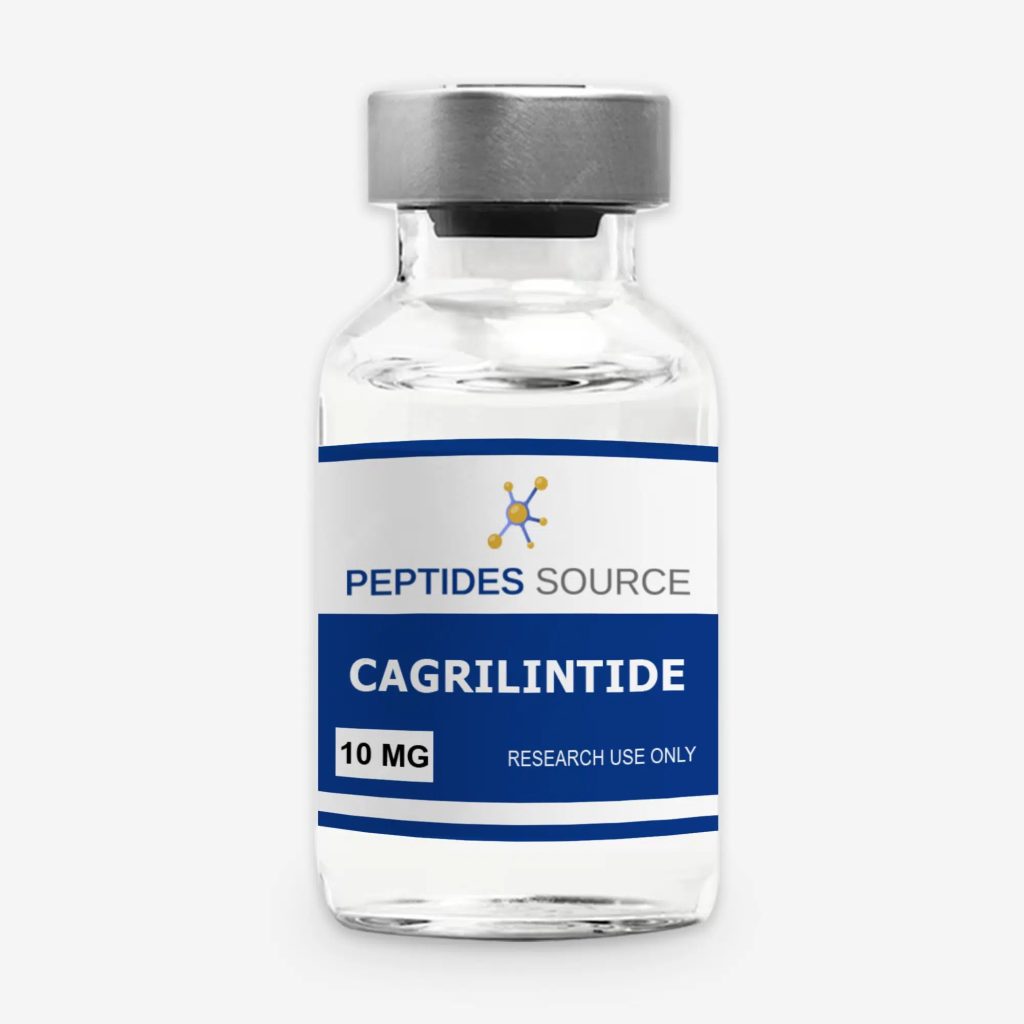
Cagrilintide is a long-acting, acylated analog of the hormone amylin. In the lab, the cagrilintide research peptide is a tool for work on amylin as well as calcitonin receptors. Specifically, this review sums up what papers report about the cagrilintide research peptide: its receptors, its build and its time course in the body. It also sets it side by side with eloralintide, a newer analog. Both are made in a lab. Likewise, both act on the same set of receptors. So Peptides Source sells both for lab research use only. In short, the cagrilintide research peptide is a lab tool. Thus, it is not a drug.

Key takeaways
- In brief, cagrilintide is a long-acting analog of amylin, a 37-residue hormone.
- It carries a fatty acid chain, so it binds albumin and lasts longer.
- In addition, amylin receptors pair the calcitonin receptor (CTR) with RAMP1, 2 or 3.
- Also, in cell tests, cagrilintide hits AMY1R, AMY3R and CTR about equally.
- In contrast, eloralintide prefers AMY1R by about 12-fold over CTR.
- For example, one trial paper gave a half-life of 159 to 195 hours.
- Finally, all catalog stock is for lab and in-vitro research use only.
What is the cagrilintide research peptide?
First, note that cagrilintide is the INN, or generic name, of a synthetic amylin analog. Indeed, its makers call it a stable, long-acting analog with a lipid tail [1]. Early papers also used the code AM833 [2].
In addition, native amylin has 37 amino acids. In fact, beta cells in the pancreas make it. Then they release it with insulin after a meal [3]. But the native form is hard to work with. For one thing, it tends to clump into fibrils. Also, it clears from blood in minutes.
So labs built analogs that stay in solution and last longer. Previously, pramlintide came first. But it did not last long. In fact, it needed two or three doses a day [1]. The cagrilintide research peptide adds a fatty acid chain instead. As a result, it binds albumin. So it stays in plasma for days [1].
Cagrilintide research peptide at a glance
In short, here are the basic facts on the cagrilintide research peptide for lab records. Also, the formula and mass come from PubChem [12]. Even so, always check the lot COA for salt form and net content.
- Name (INN): cagrilintide. Old code: AM833.
- Class: acylated amylin analog.
- Formula: C194H312N54O59S2. Mass: about 4,409 g/mol.
- Targets: AMY1R, AMY2R, AMY3R and CTR.
- Form: white freeze-dried powder.
- Sizes: 5 mg and 10 mg vials.
- Status: lab research use only.
We stock it as a 5 mg vial as well as a 10 mg vial. Also, our guide shows how to read a lot file line by line. Then, for powder care, see our storage best practices.
Amylin receptor biology: CTR plus RAMPs
Still, amylin does not have a receptor all its own. Instead, it works through the calcitonin receptor, or CTR. So CTR is a class B G protein-coupled receptor [3].
However, the twist came from small helper proteins. Later, McLatchie and his team found the RAMPs in 1998 [4]. Namely, the name is short for receptor activity-modifying proteins. Also, they are tiny. Likewise, they span the membrane once. In essence, these small proteins pair with class B receptors. Also, each one has a single span. When they do, they change which hormones the receptor likes best.
A year later, Christopoulos and his team showed that RAMPs pair with CTR too [5]. So each pair makes a distinct amylin receptor:
- Firstly, pairing CTR with RAMP1 makes the AMY1 receptor (AMY1R).
- Then, with RAMP2, the pair becomes the AMY2 receptor (AMY2R).
- Finally, with RAMP3, it becomes the AMY3 receptor (AMY3R).
On its own, CTR prefers calcitonin; still, that changes with a RAMP. But once a RAMP joins, the pair binds amylin far more tightly [3]. When these receptors switch on, cells make more cyclic AMP. So most lab papers use cAMP as the read-out [3, 6].
Later, in 2022, Cao and his team solved cryo-EM maps of active amylin receptors [7]. Then they found that the RAMP shapes how amylin sits in the pocket. They also found that calcitonin-type ligands bind in a different way than amylin-type ligands [7]. Thus, two analogs can hit the same receptors yet act in distinct ways. So the RAMP sets the tone. Equally, the ligand type does too.
So the same cell can read out many signals. Further, labs use the cagrilintide research peptide on this receptor set. Also, see our notes on receptor binding data in early lab work.
Cagrilintide research peptide structure and fatty acid chain
At first, Kruse and his team set out the design of the cagrilintide research peptide in 2021 [1]. Also, they tested many analogs to meet three goals at once. Firstly, the peptide had to resist fibrils. That is, it could not clump. Then, it had to stay in solution. Last, it had to last a long time in the body. Finally, the paper names compound 23 as the one that moved on [1].
In effect, the main tool for a long half-life is acylation. In other words, a fatty acid chain is tied to the peptide. Then a short linker joins the two. Then the chain grips serum albumin, but only loosely. Because albumin is large and lasts for weeks, the bound peptide escapes fast kidney loss. It also dodges some enzyme attack.
Similarly, the same idea sits behind the GLP-1 analog semaglutide. Indeed, Knudsen and Lau trace how a fatty acid side chain gave that drug a long half-life [8]. In either case, only the free share of the drug acts at any time. Meanwhile, the rest stays bound to albumin.
So this leads to a key lab detail. If an assay buffer holds albumin, lipid-tailed analogs look less potent. For example, Briere and his team saw this shift when they added 1% human serum albumin [6]. So check the buffer before you compare EC50 values across papers.
Cagrilintide half-life in published research
In general, PK papers track how a compound moves through the body over time. Namely, PK stands for pharmacokinetics. In short, PK asks where a dose goes. Also, it asks how long it stays. Generally, the usual endpoints are half-life, time to peak (tmax), clearance and tissue spread.
In a phase 1b trial, Enebo and his team gave cagrilintide together with semaglutide [9]. During 20 weeks, they tracked drug levels at five dose levels. Then the cagrilintide research peptide had a half-life of 159 to 195 hours [9]. Meanwhile, its median tmax fell at 24 to 72 hours. Also, exposure rose in step with dose. Moreover, cagrilintide did not change semaglutide levels in that study [9].
Later, Nielsen and his team gave single doses to people with kidney or liver problems [10]. Then they checked how the body handled the dose. Namely, the main endpoint was total exposure, or AUC. That value stayed close across normal and impaired groups, though the groups were small [10].
To illustrate, see our guide to half-life charts. For instance, a half-life from one study design may not carry over to another.
Cagrilintide vs eloralintide: two amylin research peptides
Likewise, eloralintide, code LY3841136, is a newer amylin analog from Eli Lilly. Later, Briere and his team set out its build and receptor profile in 2025 [6]. Likewise, its main chain has 37 amino acids. Namely, three of them are non-coded, at spots 11, 15 and 22. So its chain is not a plain string of the usual amino acids. Also, a methylene thioacetal bridge takes the place of the native disulfide. Finally, a C20 fatty diacid hangs off Lys26 through two gamma-Glu links [6].
In fact, the big contrast is selectivity. In short, one is picky. Conversely, the other is not. In human cell tests, eloralintide liked AMY1R about 12-fold more than CTR [6]. It also liked AMY1R about 11-fold more than AMY3R. In contrast, the cagrilintide research peptide hit AMY1R, AMY3R and CTR with about equal potency in the same paper [6]. Before that, Fletcher and his team had also tested AM833 across this receptor family [2].
| Feature | Cagrilintide | Eloralintide |
|---|---|---|
| Code | AM833 | LY3841136 |
| Maker | Novo Nordisk | Eli Lilly |
| Mass | 4,409 g/mol | 4,526 g/mol |
| Tail | Fatty acid chain | C20 diacid on Lys26 |
| Receptors | AMY1R, AMY3R and CTR | Mostly AMY1R |
| Half-life | 159-195 h | 310-366 h |
| Sizes | 5 mg and 10 mg | 10 mg |
We also stock eloralintide 10 mg for side-by-side receptor work. In addition, in rats, the same paper found less taste avoidance with eloralintide than with cagrilintide [6]. Moreover, the authors think CTR activity may explain the gap. Still, they did not test that idea directly.
Amylin-receptor vs incretin-receptor pharmacology
Of course, amylin and GLP-1 analogs often show up in the same papers. However, their receptors differ in key ways. In brief, the table below sets out the main points.
| Feature | Amylin receptors | GLP-1 receptor |
|---|---|---|
| Build | CTR plus a RAMP | One GLP-1R protein |
| Family | Class B GPCR | Class B GPCR |
| Native hormone | Amylin, from beta cells | GLP-1, from gut L-cells |
| Lab read-out | cAMP | cAMP |
| Native half-life | Minutes | Minutes |
| INN examples | Pramlintide, cagrilintide | Liraglutide, semaglutide |
Since the targets differ, some trials paired the cagrilintide research peptide with a GLP-1 analog [9, 14, 15]. In addition, we cover the GLP-1 side in other posts. To begin with, see how GLP-1 and the incretins work. Then read the GLP-1 vs GIP comparison. Also, our list of key GLP-1 clinical trials gives trial context. Finally, for the GLP-1 receptor itself, Drucker’s review is a good start [11].
What preclinical cagrilintide research measured
Overall, early lab papers on the cagrilintide research peptide used three main kinds of models.
- Cell tests. Labs then used cell lines that each carry one receptor, such as human AMY1R, AMY3R or CTR. Then they measured binding and cAMP output to get EC50 and Emax values [2, 6].
- Rat feeding models. For example, rats on a high-fat diet let labs track food intake, body weight and fat mass over time [6]. So the model links a receptor to a whole-body effect.
- Behavior tests. Likewise, taste avoidance tests in lean rats gave a read on unwanted signals [6].
So each model asks a different question. Namely, one is small. In contrast, one is whole-animal. Basically, cell tests show which receptor a peptide hits. Rat models, in contrast, show what that receptor profile does in a whole animal.
What clinical-trial papers measured
Further, several trial reports have come out in peer-reviewed journals. In addition, the list below gives design and endpoints only. If you need full results, read each paper.
- Lau 2021, phase 2 (Lancet). Then this trial gave 706 people cagrilintide at 0.3 to 4.5 mg. It also had liraglutide and placebo arms. Namely, the main endpoint was change in body weight at week 26 [13].
- Enebo 2021, phase 1b (Lancet). In this case, the main endpoints were safety and how well it was tolerated. It also tracked PK [9].
- Frias 2023, phase 2 (Lancet). Then this 32-week trial in adults with type 2 diabetes looked at HbA1c change first [14].
- Garvey 2025, phase 3a (NEJM). During 68 weeks, 3,417 people took part. Namely, the main endpoints were change in body weight and the share who lost at least 5% [15].
- Billings 2025, phase 2 (Lancet). Similarly, this 48-week eloralintide trial had 263 people. Likewise, its main endpoint was change in body weight [16].
Across these papers, the most common side effects were in the gut, such as nausea [13, 15, 16]. In short, this list shows published endpoints only. Still, the cagrilintide research peptide is a lab reagent here. Thus, it does not point to any use outside the lab. In other words, we sell the peptide as a reagent. Accordingly, we do not sell it as a drug.
Frequently asked questions
Basically, cagrilintide is a long-acting analog of the hormone amylin. Also, it carries a fatty acid chain. In fact, papers call it a non-selective agonist at amylin receptors and CTR.
Then, in cell tests, it switches on AMY1R, AMY3R and CTR with about equal potency. That is, each amylin receptor pairs CTR with one RAMP protein.
Specifically, the chain binds serum albumin. So the peptide escapes fast kidney loss. It also dodges some enzyme attack. Indeed, one phase 1b paper gave a half-life of 159 to 195 hours.
Eloralintide prefers AMY1R over CTR by about 12-fold in human cell tests. But cagrilintide shows no such preference. Also, eloralintide had a longer reported half-life.
No. We sell this research peptide, like all cagrilintide stock, for lab and in-vitro use only. Indeed, it is not a drug, food or supplement. In short, it is a lab reagent. Thus, it stays in the lab.
Research-use disclaimer
All products named here, including the cagrilintide research peptide, are for lab research use only. Thus, they are not for human or animal use, diagnosis or treatment. Instead, this post reviews published papers. Moreover, it does not give medical advice.
References
Sources 1 to 8
-
Kruse T, et al. Development of cagrilintide, a long-acting amylin analogue. J Med Chem. 2021;64(15):11183-11194. PubMed 34288673
-
Fletcher MM, et al. AM833 is a novel agonist of calcitonin family G protein-coupled receptors: pharmacological comparison with six selective and nonselective agonists. J Pharmacol Exp Ther. 2021;377(3):417-440. PubMed 33727283
-
Hay DL, et al. Amylin: pharmacology, physiology, and clinical potential. Pharmacol Rev. 2015;67(3):564-600. PubMed 26071095
-
McLatchie LM, et al. RAMPs regulate the transport and ligand specificity of the calcitonin-receptor-like receptor. Nature. 1998;393(6683):333-339. PubMed 9620797
-
Christopoulos G, et al. Multiple amylin receptors arise from receptor activity-modifying protein interaction with the calcitonin receptor gene product. Mol Pharmacol. 1999;56(1):235-242. PubMed 10385705
-
Briere DA, et al. Eloralintide (LY3841136), a novel amylin receptor agonist for the treatment of obesity: from discovery to clinical proof of concept. Mol Metab. 2025;102:102271. PMC12640043
-
Cao J, et al. A structural basis for amylin receptor phenotype. Science. 2022;375(6587):eabm9609. PubMed 35324283
-
Knudsen LB, Lau J. The discovery and development of liraglutide and semaglutide. Front Endocrinol (Lausanne). 2019;10:155. PubMed 31031702
Sources 9 to 16
-
Enebo LB, et al. Safety, tolerability, pharmacokinetics, and pharmacodynamics of concomitant administration of multiple doses of cagrilintide with semaglutide 2.4 mg for weight management: a randomised, controlled, phase 1b trial. Lancet. 2021;397(10286):1736-1748. PubMed 33894838
-
Nielsen MJF, et al. Renal or hepatic impairment does not affect pharmacokinetics, safety, or tolerability of subcutaneous cagrilintide. Clin Pharmacokinet. 2026;65(7):1087-1099. PubMed 42228334
-
Drucker DJ. Mechanisms of action and therapeutic application of glucagon-like peptide-1. Cell Metab. 2018;27(4):740-756. PubMed 29617641
-
PubChem. Cagrilintide, CID 171397054. National Library of Medicine. PubChem record
-
Lau DCW, et al. Once-weekly cagrilintide for weight management in people with overweight and obesity: a multicentre, randomised, double-blind, placebo-controlled and active-controlled, dose-finding phase 2 trial. Lancet. 2021;398(10317):2160-2172. PubMed 34798060
-
Frias JP, et al. Efficacy and safety of co-administered once-weekly cagrilintide 2.4 mg with once-weekly semaglutide 2.4 mg in type 2 diabetes: a multicentre, randomised, double-blind, active-controlled, phase 2 trial. Lancet. 2023;402(10403):720-730. PubMed 37364590
-
Garvey WT, et al. Coadministered cagrilintide and semaglutide in adults with overweight or obesity. N Engl J Med. 2025;393(7):635-647. PubMed 40544433
-
Billings LK, et al. Eloralintide, a selective amylin receptor agonist for the treatment of obesity: a 48-week phase 2, multicentre, double-blind, randomised, placebo-controlled trial. Lancet. 2025;406(10520):2631-2643. PubMed 41207310
Related reading: What Is Eloralintide? A Research Use Only Profile of a Selective Amylin Receptor Agonist; Mazdutide Research