
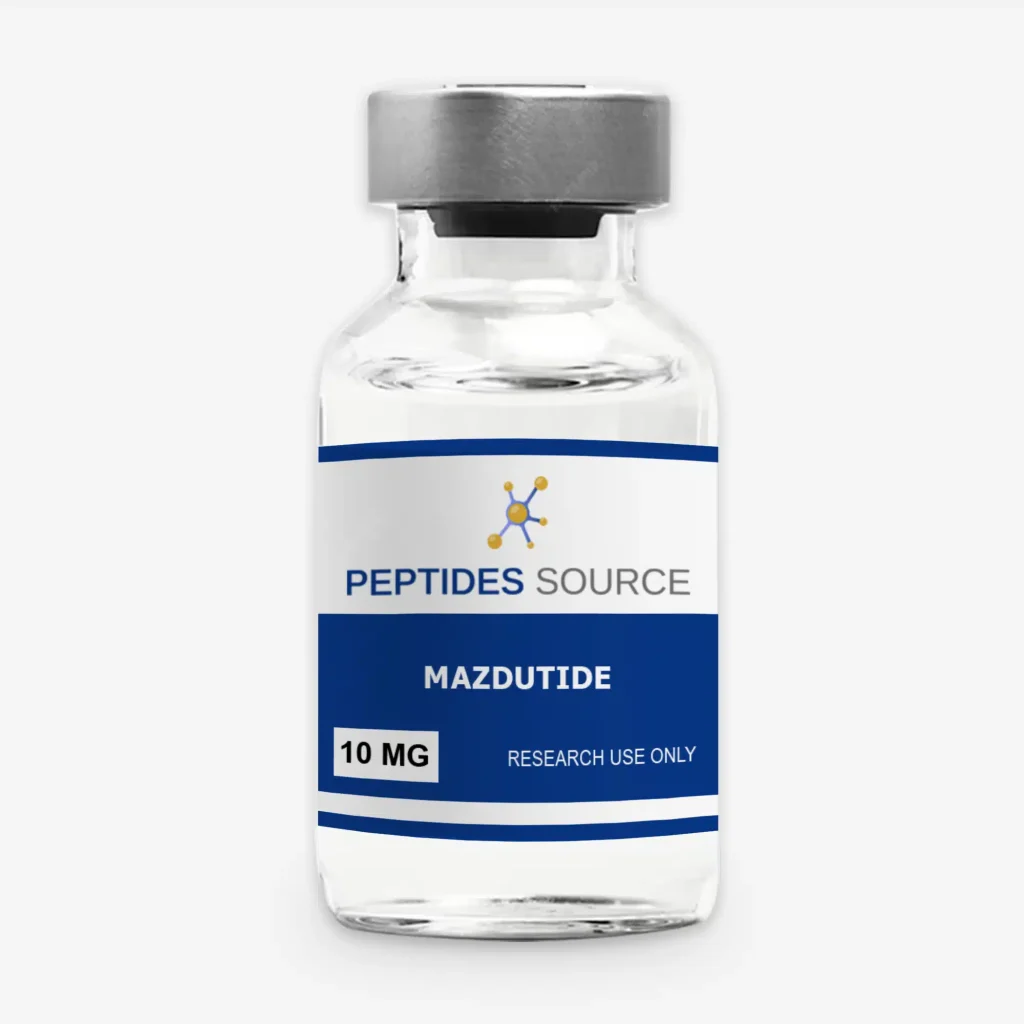
In brief, mazdutide is a long-acting analog of the gut hormone oxyntomodulin. Within the lab, mazdutide research uses this peptide as a tool for work on the GLP-1 receptor as well as the glucagon receptor. Specifically, this review sums up what papers report about mazdutide research: its receptors, its build and its time course in the body. Further, Peptides Source sells it for lab research use only. In short, this peptide is a lab tool. Thus, it is not a drug.
Key takeaways
- In brief, mazdutide is a long-acting analog of oxyntomodulin, a gut hormone.
- It carries a fatty-acyl chain, so it lasts longer in plasma.
- In addition, it acts at both the GLP-1 receptor and the glucagon receptor.
- Also, in cell tests, papers report binding at human and mouse GLP-1R and GCGR.
- Likewise, in mice, both receptor paths can still contribute in knockout models.
- For example, one trial paper gave a half-life of 150.9 to 403.5 hours.
- Later, papers reported a wider half-life range across people.
- Finally, all catalog stock is for lab and in-vitro research use only.
What is mazdutide research?
First, note that mazdutide is the INN, or generic name, of a synthetic oxyntomodulin analog. Indeed, early papers also used the codes IBI362 and LY3305677 [6, 7]. In fact, trial reports call it a once-weekly dual agonist at the GLP-1 receptor and the glucagon receptor [6, 7].
Also, native oxyntomodulin comes from the same proglucagon path as GLP-1. Then, gut L-cells release it after a meal [1]. Also, it can switch on both the GLP-1 receptor and the glucagon receptor [1, 2]. But the native form is hard to work with. For one thing, it clears from blood in minutes.
So labs built analogs that last longer. The peptide used in mazdutide research adds a fatty-acyl chain instead [6]. As a result, it stays in plasma for days rather than minutes [6, 7].
Mazdutide research at a glance
In short, here are the basic facts on mazdutide research for lab records. Also, the formula and mass come from PubChem [8]. Even so, always check the lot COA for salt form and net content.
- Name (INN): mazdutide. Old codes: IBI362 and LY3305677.
- Class: acylated oxyntomodulin analog.
- Formula: C207H317N45O65. Mass: about 4,476 g/mol.
- CAS: 2259884-03-0.
- Targets: GLP-1R and GCGR.
- Form: white freeze-dried powder.
- Size: 10 mg vial.
- Status: lab research use only.
In addition, we stock it as a 10 mg vial. Also, our guide shows how to read a lot file line by line. Then, for powder care, see our storage best practices.
GLP-1 and glucagon receptor biology
Still, oxyntomodulin does not have a receptor all its own. Instead, it works through two known class B G protein-coupled receptors [1, 2]. In fact, Baggio and her team found no separate, unique receptor for the native hormone [2].
Firstly, the target is the GLP-1 receptor, or GLP-1R. In particular, Drucker reviews how this receptor works in cells and tissues [3]. When the receptor switches on, cells often make more cyclic AMP. So most lab papers use cAMP as the read-out [3].
Then, the second target is the glucagon receptor, or GCGR. Likewise, Müller and his team review this receptor and the hormone glucagon [4]. Indeed, GCGR is rich in the liver. When it switches on, liver cells can raise glucose output. Also, papers discuss effects on fat use and energy balance [4].
However, that pairing creates a key design issue. In particular, GCGR activity can raise glucose output. At the same time, GLP-1R activity can support insulin release and thus offset that rise [1]. Therefore, early lab groups built dual GLP-1R and GCGR peptides to study this balance in rodents [5]. For example, Day and his team set out one of those first design papers in 2009 [5].
Further, labs use mazdutide research on this receptor pair. Also, see our notes on receptor binding data in early lab work. In addition, we cover the GLP-1 side in how GLP-1 and the incretins work.
Mazdutide research: structure and the fatty acid chain
At first, Jiang and his team set out the build used in mazdutide research in a 2022 trial paper [6]. Indeed, they call IBI362 a mammalian oxyntomodulin analog. They also say it has a fatty-acyl moiety that extends half-life [6]. Later, papers use the same description for mazdutide research: an oxyntomodulin analog with a fatty acid side chain [10].
In effect, the main tool for a long half-life is acylation. That is, a fatty acid chain is tied to the peptide. Then the chain grips serum albumin, but only loosely. Because albumin is large and lasts for weeks, the bound peptide escapes fast kidney loss. It also dodges some enzyme attack.
Similarly, the same idea sits behind the GLP-1 analog semaglutide. Indeed, Knudsen and Lau trace how a fatty acid side chain gave that peptide a long half-life [9]. In either case, only the free share of the peptide acts at any time. Meanwhile, the rest stays bound to albumin.
Consequently, this leads to a key lab detail. If an assay buffer holds albumin, lipid-tailed analogs can look less potent. So check the buffer before you compare EC50 values across papers.
Mazdutide research half-life in published papers
In general, PK papers track how a compound moves through the body over time. Namely, PK stands for pharmacokinetics. In short, PK asks where a dose goes. Also, it asks how long it stays. Generally, the usual endpoints are half-life, time to peak (tmax), clearance and tissue spread.
In a phase 1b trial, Ji and his team gave IBI362 once a week for 12 weeks [7]. Then they tracked drug levels after the first dose. In short, the peptide showed slow absorption. Namely, peak levels (Cmax) fell between 11.8 and 120 hours. Meanwhile, the median tmax was 72 hours. Then levels declined slowly. After that, one mazdutide research paper gave a half-life of 150.9 to 403.5 hours, or 6.3 to 16.8 days [7].
Later, Jiang and his team reported PK in people with type 2 diabetes [6]. Namely, Cmax fell between 23.3 and 144.2 hours. Likewise, the median tmax was about 72 hours. Then the half-life ranged from 147.3 to 673.3 hours, or 6.1 to 28.1 days [6].
A further phase 1b paper looked at higher steps, up to 9 mg and 10 mg [10]. Following the first dose, Cmax fell between 12.1 and 170.2 hours. Likewise, the median tmax was about 72 hours. But the half-life range was wider: 174.8 to 1,075.7 hours, or 7.3 to 44.8 days [10]. So published half-life estimates varied a lot by study and by person.
Published half-life ranges
In brief, the table below groups those published ranges.
| Paper | Median tmax | Published half-life range |
|---|---|---|
| Ji 2021, phase 1b [7] | 72 h | 150.9-403.5 h |
| Jiang 2022, phase 1b [6] | ~72 h | 147.3-673.3 h |
| Ji 2022, phase 1b [10] | ~72 h | 174.8-1,075.7 h |
To illustrate, see our guide to half-life charts. For instance, a half-life from one study design may not carry over to another.
GLP-1-receptor vs glucagon-receptor pharmacology
Of course, GLP-1 analogs and glucagon-receptor agonists often show up in the same papers. However, the two receptors differ in key ways. In brief, the table below sets out the main points.
| Feature | GLP-1 receptor | Glucagon receptor |
|---|---|---|
| Build | One GLP-1R protein | One GCGR protein |
| Family | Class B GPCR | Class B GPCR |
| Native hormone | GLP-1, from gut L-cells | Glucagon, from alpha cells |
| Lab read-out | cAMP | cAMP |
| Native half-life | Minutes | Minutes |
| INN examples | Liraglutide, semaglutide | (dual peptides, such as mazdutide) |
Mazdutide research sits on both sides of this table. That is, one chain hits both receptors. However, this pairing is not the same as a GIP and GLP-1 dual agonist. To begin with, see our GLP-1 vs GIP comparison. Also, our class notes on dual agonists and lot-check notes on the class give broader context. Finally, our list of key GLP-1 clinical trials gives trial context.
What preclinical mazdutide research measured
Overall, early lab papers in mazdutide research used three main kinds of models. Namely, Jiang and his team gave the clearest short account [6].
- Cell tests. In particular, the paper reports that IBI362 bound potently to human and mouse GLP-1 receptors and glucagon receptors in vitro [6]. So both targets are in play in cell systems.
- Knockout mouse models. Likewise, the same paper says body-weight change was still seen in Gcgr knockout mice and in Glp1r knockout mice [6]. Thus, both receptor paths can contribute in the whole animal.
- Energy-use read-outs. Finally, the same report also notes an increase in energy expenditure in mice [6].
So each model asks a different question. Namely, one is small. In contrast, one is whole-animal. Basically, cell tests show which receptors a peptide can hit. In contrast, mouse models show what that receptor profile does in a whole animal.
What clinical-trial papers measured
Further, several trial reports have come out in peer-reviewed journals. In addition, the list below gives design and endpoints only. If you need full results, then read each paper.
Phase 1b trial reports
- Ji 2021, phase 1b (EClinicalMedicine). Then this 12-week trial enrolled 36 adults in three dose-step cohorts. Namely, the main endpoints were safety and tolerability. It also tracked PK [7].
- Jiang 2022, phase 1b (Nat Commun). Then this 12-week trial enrolled 43 adults with type 2 diabetes. Namely, the main endpoints were safety and tolerability. In addition, secondary endpoints included change in HbA1c and fasting glucose [6].
Later mazdutide research trial reports
-
Ji 2023, phase 2 (Nat Commun). Then this 24-week trial randomly assigned 248 adults. Namely, the main endpoint was percent change in body weight at week 24 [11].
-
Zhang 2024, phase 2 (Diabetes Care). Then this 20-week trial assigned 250 adults with type 2 diabetes to mazdutide, dulaglutide or placebo. Namely, the main endpoint was change in HbA1c at week 20 [12].
-
Ji 2025, phase 3 (NEJM). During 48 weeks, the GLORY-1 trial assigned 610 adults. Namely, the two main endpoints at week 32 were percent change in body weight and the share who lost at least 5% [13].
-
Zhu 2026, phase 3 (Nature). Then this trial assigned 320 adults with type 2 diabetes for 24 weeks. Namely, the main endpoint was change in HbA1c at week 24 [14].
-
Gao 2026, phase 3 (JAMA). During 60 weeks, the GLORY-2 trial treated 461 adults. Namely, the two main endpoints were percent change in body weight and the share who lost at least 5% at week 60 [15].
-
Hsia 2026, phase 2 (Lancet Diabetes Endocrinol). Then this 48-week U.S. trial assigned 179 adults. Namely, the main endpoint was percent change in body weight at week 32 [16].
Across these papers, the most common side effects were in the gut, such as nausea, diarrhea and vomiting [11, 13, 15]. In short, this list shows published endpoints only. Still, the peptide used in mazdutide research is a lab reagent here. Thus, it does not point to any use outside the lab. In other words, we sell the peptide as a reagent. Accordingly, we do not sell it as a drug.
Frequently asked questions
Basically, mazdutide is a long-acting analog of the hormone oxyntomodulin. Also, it carries a fatty-acyl chain. In fact, papers call it a dual agonist at the GLP-1 receptor and the glucagon receptor.
Then, in cell tests, papers report that it binds both GLP-1R and GCGR in human and mouse systems. Similarly, native oxyntomodulin uses the same two receptors. In other words, it does not have a receptor of its own.
Specifically, the chain binds serum albumin. So the peptide escapes fast kidney loss. It also dodges some enzyme attack. Indeed, one phase 1b paper gave a half-life of 150.9 to 403.5 hours.
For example, a GLP-1-only analog, such as semaglutide, acts at GLP-1R. By contrast, this analog also acts at GCGR. So lab work can ask how the two signals interact.
No. We sell this peptide, like all catalog stock, for lab and in-vitro use only. Indeed, it is not a drug, food or supplement. In short, it is a lab reagent. Thus, it stays in the lab.
Research-use disclaimer
All products named here, including stock used in mazdutide research, are for lab research use only. Thus, they are not for human or animal use, diagnosis or treatment. Instead, this post reviews published papers. Moreover, it does not give medical advice.
References
Sources 1 to 8
-
Pocai A. Action and therapeutic potential of oxyntomodulin. Mol Metab. 2014;3(3):241-251. PubMed 24749050
-
Baggio LL, et al. Oxyntomodulin and glucagon-like peptide-1 differentially regulate murine food intake and energy expenditure. Gastroenterology. 2004;127(2):546-558. PubMed 15300587
-
Drucker DJ. Mechanisms of action and therapeutic application of glucagon-like peptide-1. Cell Metab. 2018;27(4):740-756. PubMed 29617641
-
Müller TD, et al. The New Biology and Pharmacology of Glucagon. Physiol Rev. 2017;97(2):721-766. PubMed 28275047
-
Day JW, et al. A new glucagon and GLP-1 co-agonist eliminates obesity in rodents. Nat Chem Biol. 2009;5(10):749-757. PubMed 19597507
-
Jiang H, et al. A phase 1b randomised controlled trial of a glucagon-like peptide-1 and glucagon receptor dual agonist IBI362 (LY3305677) in Chinese patients with type 2 diabetes. Nat Commun. 2022;13(1):3613. PubMed 35750681
-
Ji L, et al. IBI362 (LY3305677), a weekly-dose GLP-1 and glucagon receptor dual agonist, in Chinese adults with overweight or obesity: A randomised, placebo-controlled, multiple ascending dose phase 1b study. EClinicalMedicine. 2021;39:101088. PubMed 34430840
-
PubChem. Mazdutide, CID 167312357. National Library of Medicine. PubChem record
Sources 9 to 16
-
Knudsen LB, Lau J. The discovery and development of liraglutide and semaglutide. Front Endocrinol (Lausanne). 2019;10:155. PubMed 31031702
-
Ji L, et al. Safety and efficacy of a GLP-1 and glucagon receptor dual agonist mazdutide (IBI362) 9 mg and 10 mg in Chinese adults with overweight or obesity: A randomised, placebo-controlled, multiple-ascending-dose phase 1b trial. EClinicalMedicine. 2022;54:101691. PubMed 36247927
-
Ji L, et al. A phase 2 randomised controlled trial of mazdutide in Chinese overweight adults or adults with obesity. Nat Commun. 2023;14(1):8289. PubMed 38092790
-
Zhang B, et al. Efficacy and Safety of Mazdutide in Chinese Patients With Type 2 Diabetes: A Randomized, Double-Blind, Placebo-Controlled Phase 2 Trial. Diabetes Care. 2024;47(1):160-168. PubMed 37943529
-
Ji L, et al. Once-Weekly Mazdutide in Chinese Adults with Obesity or Overweight. N Engl J Med. 2025;392(22):2215-2225. PubMed 40421736
-
Zhu D, et al. Mazdutide versus placebo in Chinese adults with type 2 diabetes. Nature. 2026;652(8108):174-180. PubMed 41407859
-
Gao L, et al. Treatment With 9-mg Mazdutide for Weight Reduction in Chinese Adults With Obesity: The GLORY-2 Randomized Clinical Trial. JAMA. 2026;336(5):377-388. PubMed 42251595
-
Hsia SH, et al. Efficacy and safety of mazdutide in adults with obesity or overweight: a US-based, multicentre, phase 2, randomised, placebo-controlled clinical trial. Lancet Diabetes Endocrinol. 2026;14(11):879-893. PubMed 42628555
Related reading: Cagrilintide and Amylin-Receptor Agonists