
BPC-157 peptide is a synthetic 15-amino-acid peptide (a pentadecapeptide) with the sequence Gly-Glu-Pro-Pro-Pro-Gly-Lys-Pro-Ala-Asp-Asp-Ala-Gly-Leu-Val (CAS 137525-51-0; C62H98N16O22; 1419.5 g/mol), studied in cell and animal models of angiogenic and cell-migration signaling. Moreover, Peptides Source supplies BPC-157 as lyophilized research peptide in 5 mg, 10 mg, 15 mg, and 20 mg vials, made in the USA in a USP 797 sterile facility with a certificate of analysis (COA) for every batch. It is supplied for in-vitro and laboratory research only. It is not a drug and is not for human or animal use.
This is the chemistry-first identity reference for the BPC-157 peptide. In addition, for the stability and mechanism discussion, see BPC-157 research: pentadecapeptide, stability, angiogenic mechanisms.
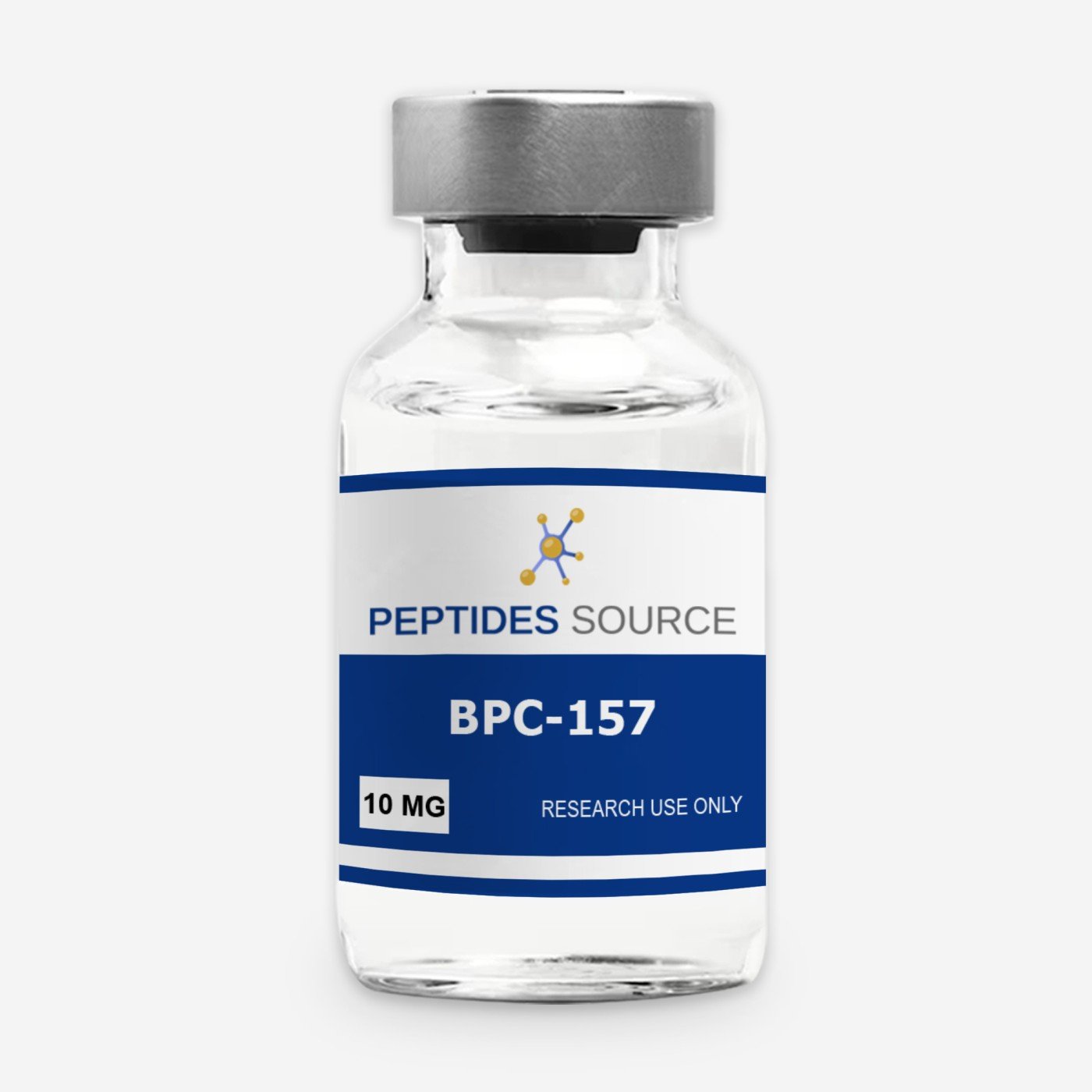
BPC-157 at a glance: identity and specifications
| Property | Value |
|---|---|
| Compound name | BPC-157 (body protection compound-157) |
| CAS number | 137525-51-0 (PubChem CID 9941957) |
| Sequence (one-letter) | GEPPPGKPADDAGLV |
| Sequence (three-letter) | Gly-Glu-Pro-Pro-Pro-Gly-Lys-Pro-Ala-Asp-Asp-Ala-Gly-Leu-Val |
| Length | 15 residues (pentadecapeptide), free acid |
| Molecular formula | C62H98N16O22 |
| Molecular weight | 1419.5 g/mol (average, free base, per PubChem) |
| Monoisotopic mass | 1418.70 Da |
| Physical form | Lyophilized white powder |
| Catalog strengths | 5, 10, 15, and 20 mg vials; capsule and arginine-salt presentations where offered |
| Listed purity | Greater than 98% by HPLC (confirm the exact value on the lot COA) |
| Origin | Manufactured in the USA, USP 797 sterile facility |
| Status | Research use only. Not for human or animal use |
The gross powder weight of a lyophilized BPC-157 peptide includes counter-ions and residual water; use the net peptide content on the COA when preparing a stock solution.
What is the BPC-157 peptide? Structure and sequence
The BPC-157 peptide is a synthetic pentadecapeptide — 15 amino acids. Additionally, the literature describes its sequence, GEPPPGKPADDAGLV, as a partial sequence derived from a protein isolated from gastric juice (Chang et al., 2011, Journal of Applied Physiology). The sequence is notable for three consecutive proline residues (Pro-Pro-Pro) near the N-terminus, which contribute to a relatively constrained backbone, and for two aspartate residues that give the peptide acidic character. All residues are standard L-amino acids, so a one-letter string represents the backbone — but identity should still be confirmed by mass spectrometry for each lot.
How BPC-157 is studied: laboratory-model literature
For example, researchers have examined the BPC-157 peptide in a range of cell and rodent experimental systems. Reported work describes associations with angiogenesis-related signaling — for example, up-regulation and internalization of VEGFR2 and activation of the VEGFR2-Akt-eNOS pathway in vascular endothelial cell cultures and in rat hind-limb ischemia models (Hsieh et al., 2017, Journal of Molecular Medicine). Other studies describe effects on fibroblast outgrowth, survival under oxidative stress, and in-vitro cell migration, associated with the FAK-paxillin pathway in tendon-explant and cell-culture systems (Chang et al., 2011). Broader reviews summarize the preclinical literature (Sikiric et al., 2024, Pharmaceuticals).
In short, these BPC-157 peptide findings come from defined cell and animal experimental systems. They describe molecular pathways and assay outcomes studied in the laboratory. They do not establish any effect in people, and nothing here should be read as a human claim about healing, recovery, tissue repair, or any other outcome.
How BPC-157 differs from TB-500
However, the BPC-157 peptide is frequently confused or paired with TB-500. They are different peptides: BPC-157 is a 15-residue synthetic sequence, while TB-500 is supplied as an acetylated fragment related to thymosin β4. They have separate sequences and separate literature. Pre-combined vials pairing the two exist, such as the BPC-157 / TB-500 combo 10 mg and a BPC 10 mg / TB 10 mg presentation. BPC-157 also appears in the multi-component Glow and Klow blends. For the full structural comparison, see our BPC-157 vs TB-500 research comparison.
Analytical verification: what a BPC-157 COA should show
Therefore, for the BPC-157 peptide, confirm that the certificate is specific to your lot and includes:
- Lot number matching the vial label.
- Identity by mass spectrometry. The observed mass should agree with the expected monoisotopic mass of about 1418.70 Da, reported as the [M+H]+ ion near m/z 1419.7 or as a multiply charged ion.
- Purity by reversed-phase HPLC, with chromatogram, detection wavelength, and main-peak percentage. Peptides Source lists greater than 98% purity; the lot value should be on the certificate.
- Net peptide content or assay, where reported.
- Endotoxin (LAL) result, where published.
- Issuing laboratory, so the report can be verified.
In addition, certificates for the BPC-157 peptide are published in the COA library; the approach is described in COA and testing explained.
Catalog presentations and laboratory handling
Also, Peptides Source lists the BPC-157 peptide in 5 mg, 10 mg, 15 mg, and 20 mg lyophilized vials, with capsule and arginine-salt presentations where offered, in the Extracellular Matrix & Repair category. General handling of a lyophilized research peptide — cold, light-protected storage, reconstitution with an appropriate solvent, and aliquoting to limit freeze-thaw — is covered in our reconstitution guide and storage best practices. No dosing and no instructions for use in a living subject are given, because BPC-157 is a research reagent only.
How to evaluate a BPC-157 supplier
- A lot-matched COA with HPLC and MS, not a reused generic certificate.
- A named laboratory that can confirm the report.
- Accurate chemical identity (the 15-residue sequence, formula, and mass above).
- Research-use-only labeling with no human-use or outcome claims.
- Traceable USA manufacturing under the Got Peptides® mark. See also where to buy research peptides in the USA.
Frequently asked questions
What is BPC-157 as a research peptide?
In short, the BPC-157 peptide is a synthetic 15-amino-acid peptide (a pentadecapeptide; sequence GEPPPGKPADDAGLV; CAS 137525-51-0). Peptides Source supplies it as a lyophilized research compound for in-vitro and laboratory use only. It is not a medicine and is not for human or animal use.
What is the molecular weight and formula of BPC-157?
The molecular formula is C62H98N16O22 and the average molecular weight is 1419.5 g/mol for the free base, per PubChem CID 9941957. A salt form weighs more.
How is BPC-157 different from TB-500?
They are different peptides with separate sequences and literature. BPC-157 is a 15-residue synthetic peptide; TB-500 is an acetylated fragment related to thymosin β4. They are not interchangeable.
Which presentations does Peptides Source supply?
Additionally, Peptides Source lists the BPC-157 peptide in 5, 10, 15, and 20 mg lyophilized vials, plus capsule and arginine-salt presentations where offered, and in combined vials with TB-500 and in the Glow and Klow blends.
How do I verify a BPC-157 lot?
Match the BPC-157 peptide vial lot to a certificate of analysis reporting identity by mass spectrometry (expected mass about 1418.70 Da) and purity by reversed-phase HPLC, then verify the report with the issuing laboratory.
Is BPC-157 for human use?
No. In fact, Peptides Source supplies the BPC-157 peptide strictly for in-vitro and laboratory research by qualified professionals and is not for human or animal use or consumption.
Research-use-only statement
All Peptides Source compounds, including the BPC-157 peptide, are supplied strictly for in-vitro and laboratory research by qualified professionals. They are not drugs, foods, cosmetics, or dietary supplements, and they are not for human or animal use or consumption. Nothing on this page is medical advice or a claim about healing, recovery, safety, efficacy, or other outcomes in humans.