
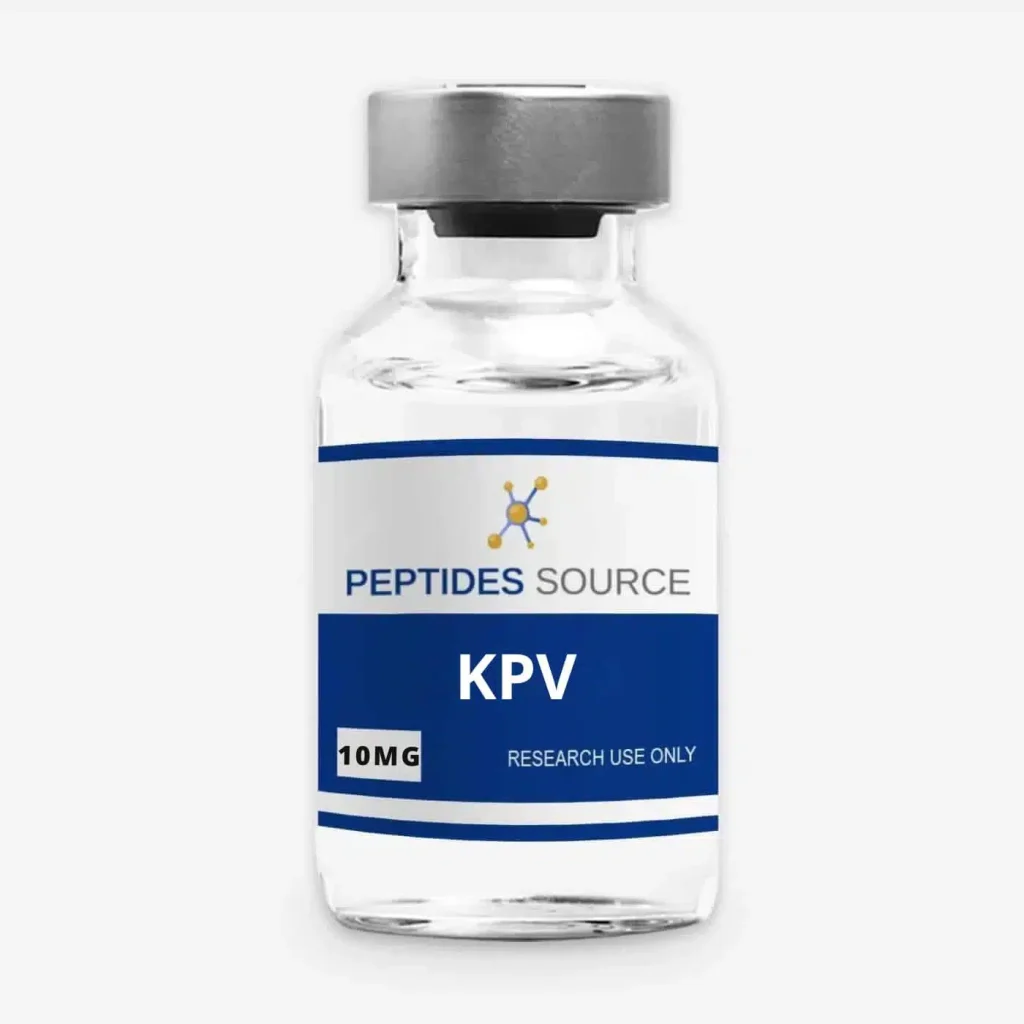
In short, the “10mg” printed on peptide vials is the label claim. Then, in most cases, it means the vial holds about 10 mg of lyophilized powder. However, that powder is not all target peptide. Instead, it also holds counter-ions, bound water and small amounts of related impurities. So three numbers matter: the fill weight, the net peptide content and the HPLC purity. Then this guide explains each one for lab work with peptide vials 10mg. Also, all Peptides Source products are for laboratory research use only.

In brief, the key takeaways are as follows:
- Put simply, the “10 mg” label usually means gross powder weight, not pure peptide.
- Likewise, net peptide content is the share of that powder that is peptide. Salts and water make up the rest.
- In addition, HPLC purity is the share of the peptide that is the correct sequence.
- For example, counter-ions such as TFA, acetate or chloride can add a lot of mass to a short chain.
- Therefore, for molar stock math, use the target mass, not the label mass.
- Finally, always check the lot COA for the numbers that apply to your vial.
Three numbers behind peptide vials 10mg labels
In general, labs often mix up three values. However, each one answers a different question.
- Gross weight (label claim). Firstly, this is the mass of dry powder filled into the vial. For peptide vials, the 10mg mark is this number.
- Net peptide content (NPC). In other words, this is the percent of the powder that is peptide of any kind. The rest is mostly counter-ions and water, so it is not peptide mass.
- HPLC purity. Then, this is the percent of the peptide signal that is the target sequence. Unlike content, it does not measure salts or water at all.
In short, purity and content are not the same. A lot can show 99% HPLC purity and still hold only 75% peptide by weight. In addition, our guide on what the HPLC number means covers the purity side in more depth.
Gross weight: the label claim on peptide vials
Most suppliers fill vials by weight or by volume of a stock solution before freeze-drying. Either way, the label states a nominal amount. So, for peptide vials 10mg, the printed claim is the target fill, not an exact value.
Still, every fill method has some spread. Namely, this spread is called the fill tolerance. For example, a lot might fill between 9.8 and 10.3 mg per vial. In any case, the COA or the batch record should state the method and the limits. If it does not, ask the supplier before you plan exact molar work.
Also, the powder can sit as a thin film on the glass. As a result, some mass stays behind when you transfer it. For this reason, many labs dissolve the whole vial in place rather than weigh out part of it.
Net peptide content explained
In brief, net peptide content tells you how much of the powder is peptide. On peptide vials 10mg, that figure is the share of the labeled powder that is peptide, not salt or water. In general, labs measure it in a few ways.
- Amino acid analysis (AAA). In this case, the peptide is broken into single amino acids, which are then counted. This method is a common reference for peptide mass [1].
- Elemental nitrogen analysis. Likewise, this method measures total nitrogen and works back to peptide mass from the formula.
- UV absorbance. Then, this method works when the chain holds Trp or Tyr, which absorb light near 280 nm.
In general, typical NPC values for synthetic peptides fall well below 100%. Notably, short, highly basic chains often show the lowest values. That is because they carry more counter-ions per unit of mass. However, the exact figure depends on the lot. Do not assume a value; instead, read it from the COA when the lab reports it.
Counter-ions in peptide vials: TFA, acetate and HCl
In general, most synthetic peptides come from solid-phase synthesis. Then the final cleavage and HPLC steps use trifluoroacetic acid (TFA). Therefore, basic residues often leave the column as TFA salts [2]. Thus, on peptide vials 10mg, those counter-ions can make up a large share of the dry mass.
In general, each positive site on the chain can pair with one counter-ion. Namely, these sites include the free N-terminus and the side chains of Lys, Arg and His. So a short chain with many basic sites can carry a large salt load.
Why the counter-ion matters in assays
Indeed, counter-ions are not always inert. For example, in 1999, Cornish and colleagues reported that TFA reduced cell numbers in osteoblast cultures at 10^-8 to 10^-7 M [3]. In the same work, the TFA salts of three peptides gave weaker growth signals than their HCl salts. For that reason, the authors advised exchange to a hydrochloride or similar salt before cell work.
Even so, exchange methods exist. For instance, Roux and colleagues compared HPLC, ion-exchange resin and a pH cycle for removing TFA [2]. In addition, Sikora and colleagues reviewed how counter-ions affect structure, solubility and activity [4].
Counter-ion mass: a worked comparison
In this case, the table uses KPV (Lys-Pro-Val) as a simple example. Namely, it has two basic sites: the N-terminus and the Lys side chain. Specifically, the free base mass is 342.43 g/mol [5]. This is a model case only, so real lots may carry more or fewer counter-ions.
| Salt form (2 counter-ions) | Counter-ion mass (g/mol) | Salt mass (g/mol) | Peptide share of salt mass |
|---|---|---|---|
| Free base | 0 | 342.43 | 100% |
| Hydrochloride (2 HCl) | 2 x 36.46 | 415.35 | 82.4% |
| Acetate (2 AcOH) | 2 x 60.05 | 462.53 | 74.0% |
| Trifluoroacetate (2 TFA) | 2 x 114.02 | 570.47 | 60.0% |
Overall, the trend is clear. For example, with TFA, salt can be 40% of the dry mass for a short chain. In contrast, longer chains with few basic sites lose a much smaller share.
Worked example: target mass in peptide vials 10mg
For example, here is a sample calculation for peptide vials with a 10mg label. In this case, the values are for teaching only. Instead, use the numbers on your own COA.
| Step | Value | Math |
|---|---|---|
| Label claim (gross fill) | 10.0 mg | From label |
| Net peptide content | 80% | From COA (example) |
| Total peptide mass | 8.0 mg | 10.0 x 0.80 |
| HPLC purity | 99.0% | From COA (example) |
| Target peptide mass | 7.92 mg | 8.0 x 0.99 |
| Non-peptide mass | 2.0 mg | Salts and water |
So, in this example, peptide vials 10mg hold about 7.9 mg of the target chain. Thus, that gap matters for any molar work. If you use 10 mg in your math, your stock will be about 21% weaker than you think.
Worked molarity example for an in-vitro stock solution
For instance, this example shows how to make a 10 mM stock for a cell assay. Specifically, it uses KPV free base (342.43 g/mol) and the target mass from the table above.
- Find moles. Firstly, 7.92 mg ÷ 342.43 g/mol = 23.1 µmol.
- Find volume for 10 mM. Then, 23.1 µmol ÷ 10 mM = 2.31 mL of solvent.
- Dilute to a working level. For a 10 µM assay, dilute the stock 1 in 1,000. As an example, add 1 µL of stock to 999 µL of medium.
- Check with C1V1 = C2V2. Finally, 10 mM x 1 µL = 10 µM x 1,000 µL. The two sides match.
By comparison, consider the naive route for the same peptide vials at 10mg. If you use the 10.0 mg label, you get 29.2 µmol. After that, you add 2.92 mL for a “10 mM” stock. In fact, the real level is only 7.9 mM. Then that error carries into every dilution after it.
As a rule, always use the molar mass of the free peptide when you start from target mass. Otherwise, you count the salt twice. For this purpose, see our reconstitution guide.
How to read a COA for peptide vials 10mg
In general, a good COA ties these numbers to one lot. Specifically, look for these items:
- Lot number that matches the vial label, so you can tie the report to the vial
- HPLC purity with the trace and method, including the integration report
- Also, a mass spectrometry result that confirms identity
- Net peptide content, if the lab tested it
- Counter-ion type, if stated
- Finally, the lab name and a way to verify the report
Even so, not every COA lists net peptide content. When it is missing, treat the label as gross weight. Then plan your assay with that limit in mind, since 10mg on peptide vials may overstate the target mass. In addition, our walk-through on how to read a lot COA shows each section. Likewise, for the role of mass spec, see HPLC versus mass spectrometry.
Storage factors that change the numbers
Over time, then, lyophilized powder pulls in water from the air. As a result, an opened vial can gain mass over time. Of course, that extra mass is water, not peptide. So keep vials sealed, cold and dry until use. In particular, storage can change the numbers on peptide vials 10mg if a vial sits open. Then let them warm to room temperature before you open them.
For example, see our notes on storing freeze-dried material. You can also review common handling mistakes labs make with sealed vials.
Glossary
- Label claim: namely, the nominal amount printed on the vial.
- Gross weight: that is, total dry powder mass, including salts and water.
- Net peptide content (NPC): in other words, the percent of powder mass that is peptide.
- HPLC purity: specifically, the percent of the peptide signal that is the target sequence.
- Counter-ion: an ion, such as TFA, acetate or chloride, paired with charged sites on the chain.
- Fill tolerance: namely, the allowed spread of fill weight within a lot.
- Target mass: that is, gross weight x NPC x purity.
- Molarity: in short, moles of solute per liter of solution.
Frequently asked questions
In short, usually not. That is, on peptide vials, 10mg is the gross powder weight. Then the target peptide mass equals that weight times the net peptide content times the HPLC purity.
In short, HPLC purity compares the target to other peptide species. Meanwhile, net peptide content compares all peptide to the full powder mass. In other words, purity ignores salts and water, while content does not.
In general, TFA often stays behind as a counter-ion after HPLC. For example, one 1999 study found that TFA lowered osteoblast cell counts at very low levels. So some labs exchange it for acetate or chloride first.
Generally, use the target peptide mass and the free peptide molar mass. Instead, use the full salt mass with the salt molar mass. In either case, do not mix the two.
Rather, Peptides Source sells all vials for laboratory and in-vitro research use only. Further, they are not for human or animal use.
Research-use disclaimer
In sum, all products named here are for laboratory research use only. Also, they are not drugs, foods or supplements. Likewise, they are not for human or veterinary use. Finally, the math in this article is for lab stock solutions only.
References
-
Rutherfurd SM, Gilani GS. Amino acid analysis. Curr Protoc Protein Sci. 2009;Chapter 11:Unit 11.9. PubMed 19937719
-
Roux S, et al. Elimination and exchange of trifluoroacetate counter-ion from cationic peptides: a critical evaluation of different approaches. J Pept Sci. 2008;14(3):354-359. PubMed 18035848
-
Cornish J, et al. Trifluoroacetate, a contaminant in purified proteins, inhibits proliferation of osteoblasts and chondrocytes. Am J Physiol. 1999;277(5):E779-E783. PubMed 10567002
-
Sikora K, et al. The role of counter-ions in peptides: an overview. Pharmaceuticals (Basel). 2020;13(12):442. PMC7761850
-
PubChem. Lys-Pro-Val, CID 125672. National Library of Medicine. PubChem record
Related reading: LL-37: The Human Cathelicidin Antimicrobial Peptide — Structure, Membrane Mechanism and In-Vitro Assay Considerations