

Sermorelin vials hold the amide of growth-hormone-releasing factor (1-29). Labs also call it GRF(1-29)-NH2. Peptides Source supplies this reagent for laboratory research use only. It is not a drug. It is not for human consumption. Live listings include a catalog listing and a 10 mg listing.
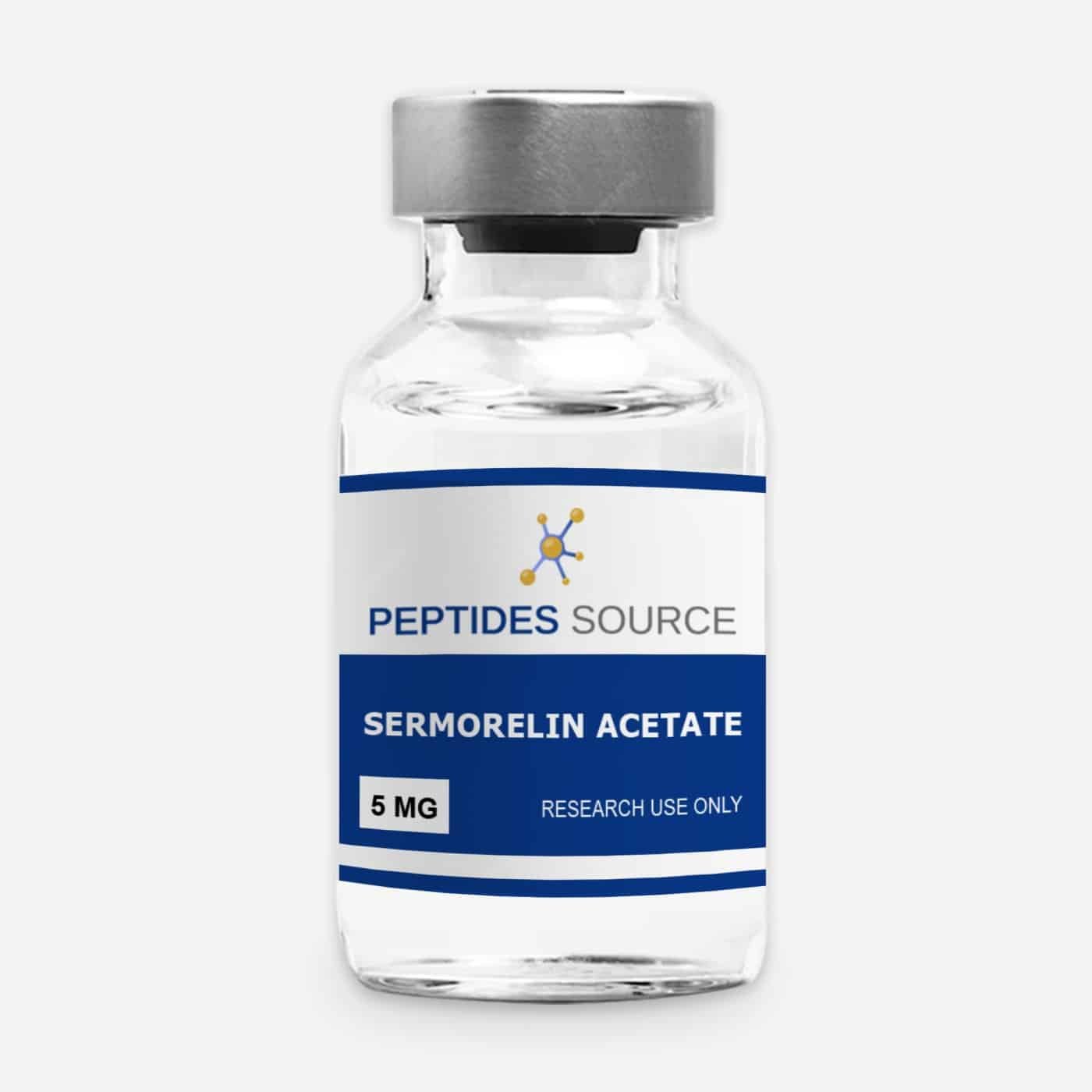
Why sermorelin vials need lot paperwork
Labs order this analog as a named reagent. Then they must prove what arrived. In fact, the incoming label is only the start of the trail. A lot certificate is that proof. The file should match the label lot. It should also match the stated form and mass. If those lines disagree, the lot is not ready for a careful assay.
Peptides Source publishes lot files in the certificate library. Therefore a buyer can read a file for this analog before placing an order. In addition, the same library lists other lots from the same shop. Sermorelin vials still need a lot-matched file, not a generic sheet.
What this analog is, in brief
The commonly listed sequence is Tyr-Ala-Asp-Ala-Ile-Phe-Thr-Asn-Ser-Tyr-Arg-Lys-Val-Leu-Gly-Gln-Leu-Ser-Ala-Arg-Lys-Leu-Leu-Gln-Asp-Ile-Met-Ser-Arg-NH2, or YADAIFTNSYRKVLGQLSARKLLQDIMSR-NH2 in one-letter code. PubChem lists a record under CID 16132413, formula C149H246N44O42S, and an average mass of 3357.9 g/mol. CAS 86168-78-7 is used for this amide. An acetate-related CAS, 114466-38-5, also appears in records. Confirm the exact salt and the observed mass on the lot certificate. This 29-residue amide is a fragment of the longer GHRH sequence first described from a human pancreatic tumor extract by Guillemin et al., 1982. That paper is a source paper for the parent factor. It is not a use claim for this catalog reagent. This page does not describe growth, secretion, or treatment in people.
Catalog sizes for sermorelin vials
Check the live size on the product pages before you lock a protocol. However, stock can change. So write the size you received, not the size you expected. In short, only the filled mass changes. The certificate must still match that exact lot. A comparison page, this analog versus ipamorelin, can help you keep the names apart. Then return here for lot checks.
Sermorelin vials in mixed cartons should be sorted by lot at once.
What a lot certificate should show
Confirm these lines on every lot certificate for this analog:
- A lot number that matches the label.
- Identity by mass spectrometry, with an observed mass that fits the stated form.
- Purity by reversed-phase HPLC, with a chromatogram and a main-peak value.
- Net peptide content, when the lab reports it.
- An endotoxin result, when the lab reports it.
- The name of the testing lab, so you can verify the file.
Still, the lot value on the certificate is the value that counts. For example, two lots can both meet the listing and still differ by a small amount. Related impurity classes are reviewed by D’Hondt et al., 2014. That paper is a methods review. It does not describe use in a person. After that review, sermorelin vials should still be checked against their own lot file.
How sermorelin vials differ from nearby reagents
Ipamorelin is a different chain and a different receptor-class tool. A protocol that names this 29-residue amide should receive that reagent, not a substitute from another class. Do not treat those pages as use guides.
In particular, sermorelin vials should not be swapped for a different catalog item without a protocol change. For method context, see testing explained.
Lab handling notes, without a use protocol
Keep the lyophilized reagent cold and protected from light. Meanwhile, keep the lot file with the same box. Reconstitute it with a suitable lab solvent. Use the concentration your study protocol requires. Then aliquot the solution to limit freeze-thaw cycles. Those steps are reagent handling only.
For bench detail, see the reconstitution steps and storage best practices. Neither page is a dosing guide. Neither page describes use in a living subject. The filled powder weight includes salts and leftover water. Therefore the net peptide line on the certificate is the line to use when you prepare a stock for an assay.
How to record a lot and fill gaps
Write the catalog name first. To begin with, use the name printed on the label. Then write the size you received. Next write the lot number from the label. After that, file a copy of the certificate with the same lot number. In this way the trail stays easy to audit.
If a later repeat assay uses a new lot, start a new line. Do not mix lots in one stock tube. Also do not file a generic certificate in place of a lot-matched file. These habits protect the data trail. They are not a use protocol.
Some files omit a line you hoped to see. In this case, treat the gap as open work. Write the gap in the notebook. Then ask the supplier for the missing item. A blank is not a pass. It is only a blank. If the file still lacks a mass result after that ask, do not treat the lot as fully documented. Wait for the file you need. Then continue the assay plan.
Checks before you order sermorelin vials
- The product is labeled for research use only.
- A lot-matched certificate is available, not a generic sheet.
- You can verify the file with the named lab.
- The filled mass matches the protocol need.
- The catalog page and the background page agree on the compound name.
For supplier context, see where to buy in the USA. In short, sermorelin vials belong in a lab inventory with a clear lot trail.
Frequently asked questions
How do I confirm sermorelin vials on arrival?
Match the label lot to a certificate. Then confirm identity by mass spectrometry and purity by HPLC. After that, verify the file with the issuing lab. Files appear in the certificate library.
How do I start with the background page?
Of course, you can start on the background page. Open the catalog listing. Then use this page for lot checks and catalog notes.
Is this analog for human use?
No. Peptides Source supplies this reagent for in-vitro and lab work by qualified staff. It is not for human or animal use or consumption. Finally, keep that limit on every notebook line.
Research-use-only statement
All Peptides Source compounds are for laboratory research use only, not for human consumption. They are not drugs, foods, cosmetics, or supplements. They are not for human or animal use. Nothing on this page is medical advice. This page also gives no dosing or administration instructions. It makes no claim about safety, benefit, or any outcome in people.
References
- D’Hondt, M., Bracke, N., Taevernier, L., Gevaert, B., Verbeke, F., Wynendaele, E., & De Spiegeleer, B. (2014). Related impurities in peptide medicines. Journal of Pharmaceutical and Biomedical Analysis, 101, 2–30. PMID 25044089.
- Guillemin, R., Brazeau, P., Böhlen, P., Esch, F., Ling, N., & Wehrenberg, W. B. (1982). Growth hormone-releasing factor from a human pancreatic tumor that caused acromegaly. Science, 218(4572), 585–587. PMID 6812220. Cited here only as a source paper for the parent factor, not as a use claim.
- National Library of Medicine. PubChem Compound Summary for CID 16132413. PubChem CID 16132413.
Related reading: 5-Amino-1MQ Vials; IGF-1 LR3 Vials