
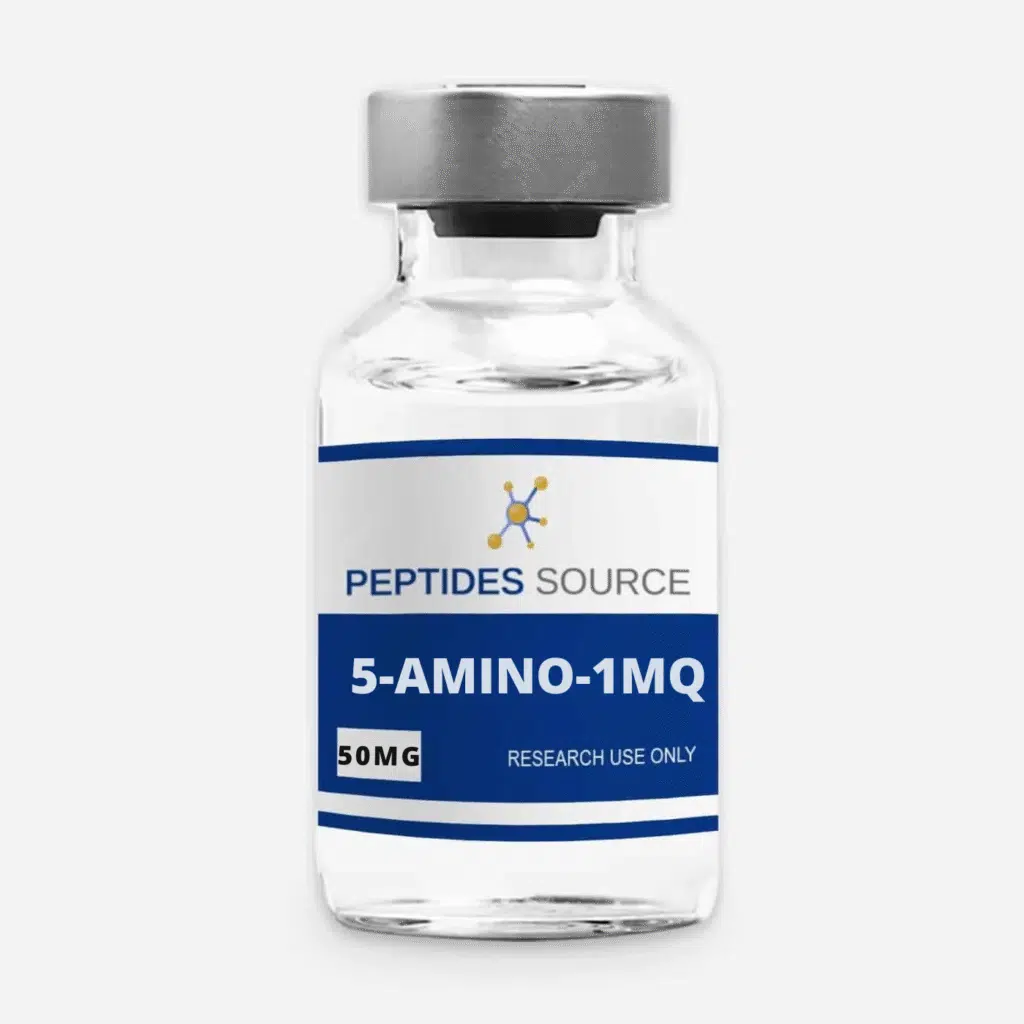
5-Amino-1MQ vials hold a small-molecule nicotinamide N-methyltransferase (NNMT) probe. It is not a peptide. Peptides Source still lists it in the catalog, and this page treats it as a lab reagent only. It is not a drug. It is not for human consumption. The live listing is the catalog listing.
Why 5-amino-1mq vials need lot paperwork
Labs order this analog as a named reagent. Then they must prove what arrived. In fact, the incoming label is only the start of the trail. A lot certificate is that proof. The file should match the label lot. It should also match the stated form and mass. If those lines disagree, the lot is not ready for a careful assay.
Peptides Source publishes lot files in the certificate library. Therefore a buyer can read a file for this analog before placing an order. In addition, the same library lists other lots from the same shop. 5-amino-1mq vials still need a lot-matched file, not a generic sheet.
What this analog is, in brief
The compound is 1-methylquinolin-1-ium-5-amine. PubChem lists the cation under CID 950107, formula C10H11N2+, and an average mass of 159.21 g/mol. CAS 685079-15-6 appears among the synonyms for this cation. The catalog material is typically a salt. Therefore the observed mass on the certificate may include a counter-ion. Use the lot file, not a generic cation mass, when you prepare a stock. Neelakantan and colleagues described this probe in an NNMT structure–activity study, with an IC50 near 1 μM in that series (Neelakantan et al., 2017). That work is a medicinal-chemistry and enzyme-assay paper. It does not establish any effect in people. This page does not describe weight, metabolism, or treatment.
Catalog sizes for 5-amino-1mq vials
Related sizes may also appear in the shop. Check the live pages before you lock a protocol. However, stock can change. So write the size you received, not the size you expected. In short, the salt form on the file is the form to use in the notebook. Labs often file this compound next to peptides because the shop carries both. The chemistry is still different. Write “small molecule, not a peptide” in the notebook so a later reader is not confused.
5-amino-1mq vials in mixed cartons should be sorted by lot at once.
What a lot certificate should show
Confirm these lines on every lot certificate for this analog:
- A lot number that matches the label.
- Identity by mass spectrometry, with an observed mass that fits the stated form.
- Purity by reversed-phase HPLC, with a chromatogram and a main-peak value.
- Net peptide content, when the lab reports it.
- An endotoxin result, when the lab reports it.
- The name of the testing lab, so you can verify the file.
Still, the lot value on the certificate is the value that counts. For example, two lots can both meet the listing and still differ by a small amount. Related impurity classes are reviewed by D’Hondt et al., 2014. That paper is a methods review. It does not describe use in a person. After that review, 5-amino-1mq vials should still be checked against their own lot file.
How 5-amino-1mq vials differ from nearby reagents
If a protocol needs a peptide control, order that peptide as its own lot. Do not treat this probe as a stand-in for a peptide standard. Do not treat those pages as use guides. A peptide-style certificate may still apply for identity and purity, but the mass math is the mass of a small-molecule salt.
In particular, 5-amino-1mq vials should not be swapped for a different catalog item without a protocol change. For method context, see testing explained.
Lab handling notes, without a use protocol
Keep the lyophilized reagent cold and protected from light. Meanwhile, keep the lot file with the same box. Reconstitute it with a suitable lab solvent. Use the concentration your study protocol requires. Then aliquot the solution to limit freeze-thaw cycles. Those steps are reagent handling only. Adjust solvent and storage to the data on this compound’s certificate when nearby pages speak to peptides in general.
For bench detail, see the reconstitution steps and storage best practices. Neither page is a dosing guide. Neither page describes use in a living subject. The filled powder weight includes salts and leftover water. Therefore the net peptide line on the certificate is the line to use when you prepare a stock for an assay.
How to record a lot and fill gaps
Write the catalog name first. To begin with, use the name printed on the label. Then write the size you received. Next write the lot number from the label. After that, file a copy of the certificate with the same lot number. In this way the trail stays easy to audit.
If a later repeat assay uses a new lot, start a new line. Do not mix lots in one stock tube. Also do not file a generic certificate in place of a lot-matched file. These habits protect the data trail. They are not a use protocol.
Some files omit a line you hoped to see. In this case, treat the gap as open work. Write the gap in the notebook. Then ask the supplier for the missing item. A blank is not a pass. It is only a blank. If the file still lacks a mass result after that ask, do not treat the lot as fully documented. Wait for the file you need. Then continue the assay plan.
Checks before you order 5-amino-1mq vials
- The product is labeled for research use only.
- A lot-matched certificate is available, not a generic sheet.
- You can verify the file with the named lab.
- The filled mass matches the protocol need.
- The catalog page and the background page agree on the compound name.
For supplier context, see where to buy in the USA. In short, 5-amino-1mq vials belong in a lab inventory with a clear lot trail.
Frequently asked questions
How do I confirm 5-amino-1mq vials on arrival?
Match the label lot to a certificate. Then confirm identity by mass spectrometry and purity by HPLC. After that, verify the file with the issuing lab. Files appear in the certificate library.
How do I start with the background page?
Of course, you can start on the background page. Open the catalog listing. Then use this page for lot checks and catalog notes.
Is this analog for human use?
No. Peptides Source supplies this reagent for in-vitro and lab work by qualified staff. It is not for human or animal use or consumption. Finally, keep that limit on every notebook line.
Research-use-only statement
All Peptides Source compounds are for laboratory research use only, not for human consumption. They are not drugs, foods, cosmetics, or supplements. They are not for human or animal use. Nothing on this page is medical advice. This page also gives no dosing or administration instructions. It makes no claim about safety, benefit, or any outcome in people.
References
- D’Hondt, M., Bracke, N., Taevernier, L., Gevaert, B., Verbeke, F., Wynendaele, E., & De Spiegeleer, B. (2014). Related impurities in peptide medicines. Journal of Pharmaceutical and Biomedical Analysis, 101, 2–30. PMID 25044089.
- Neelakantan, H., Wang, H.-Y., Vance, V., Hommel, J. D., McHardy, S. F., & Watowich, S. J. (2017). Structure–activity relationship for small molecule inhibitors of nicotinamide N-methyltransferase. Journal of Medicinal Chemistry, 60(12), 5015–5028. PMID 28548833. Cited here only for enzyme-assay and SAR data, not as a human claim.
- National Library of Medicine. PubChem Compound Summary for CID 950107. PubChem CID 950107.
Related reading: Research Grade Peptides Label; Ipamorelin 5mg Vials; MOTS-c Research