
The ipamorelin research peptide is a synthetic pentapeptide, Aib-His-D-2-Nal-D-Phe-Lys-NH2 (CAS 170851-70-4; C38H49N9O5; 711.9 g/mol), studied in laboratory models as an agonist of the growth hormone secretagogue receptor, GHSR-1a, also called the ghrelin receptor. Peptides Source supplies Ipamorelin 5 mg and Ipamorelin 10 mg as lyophilized research peptides, made in the USA in a USP 797 sterile facility, with a certificate of analysis (COA) for every batch. It is supplied for in-vitro and laboratory research only. It is not a drug and is not for human or animal use.
This page is the identity and documentation reference for the ipamorelin research peptide. In addition, for the published receptor-selectivity literature in more depth, see our article on Ipamorelin selectivity and pituitary receptor binding studies.
Ipamorelin research peptide at a glance: identity and specifications
| Property | Value |
|---|---|
| Compound name | Ipamorelin |
| Code name in the literature | NNC 26-0161 |
| CAS number | 170851-70-4 (PubChem CID 9831659) |
| Sequence (three-letter) | Aib-His-D-2-Nal-D-Phe-Lys-NH2 |
| Length | 5 residues (pentapeptide), C-terminal amide |
| Molecular formula | C38H49N9O5 |
| Molecular weight | 711.9 g/mol (average, free base, per PubChem) |
| Monoisotopic mass | 711.386 Da |
| Receptor class studied | GHSR-1a (ghrelin receptor), a G protein-coupled receptor |
| Physical form | Lyophilized white powder |
| Catalog strengths | 5 mg and 10 mg vials; also pre-combined with CJC-1295 or Tesamorelin |
| Listed purity | Greater than 98% by HPLC (confirm the exact value on the lot COA) |
| Origin | Manufactured in the USA, USP 797 sterile facility |
| Status | Research use only. Not for human or animal use |
The molecular weight above is for the neutral peptide. Lyophilized peptides are usually supplied as a salt (for example an acetate or trifluoroacetate), so the gross weight of powder in a vial includes counter-ions and residual water. The net peptide content on a COA is the figure to use when you prepare a stock solution.
What is the ipamorelin research peptide? Structure and sequence
Specifically, the ipamorelin research peptide was described in 1998 by a Novo Nordisk chemistry group as part of a series that removed the central Ala-Trp dipeptide of growth hormone-releasing peptide-1 (GHRP-1) (Raun et al., 1998, European Journal of Endocrinology). As a result, it is a short, five-residue molecule built from a mix of standard and non-standard amino acids.
The five residues, one by one
- Aib (α-aminoisobutyric acid). A non-proteinogenic residue with two methyl groups on the α-carbon. Aib restricts backbone flexibility and is a common tool in peptide design for reducing cleavage by aminopeptidases.
- His (L-histidine). A standard residue with an imidazole side chain.
- D-2-Nal (3-(2-naphthyl)-D-alanine). A synthetic aromatic residue in the D-configuration. The naphthyl group is larger than the indole of tryptophan.
- D-Phe (D-phenylalanine). The mirror-image form of phenylalanine.
- Lys-NH2 (L-lysinamide). Lysine with an amidated C-terminus, which removes the negative charge of a free carboxylate.
In short, two D-residues and one α,α-disubstituted residue in only five positions make Ipamorelin structurally distinct from native peptide hormones. These features also matter analytically: a standard one-letter sequence string cannot represent D-configuration or Aib, so identity data should rely on mass spectrometry and, where available, reference-standard comparison, not on a sequence label alone.
How Ipamorelin is studied: GHSR-1a pharmacology in laboratory models
In the original characterization, the ipamorelin research peptide stimulated growth hormone (GH) release from primary rat pituitary cells in vitro with a potency (EC50 1.3 ± 0.4 nmol/L) similar to GHRP-6. Experiments using GHRP and growth hormone-releasing hormone (GHRH) antagonists indicated that it acts through a GHRP-like receptor rather than the GHRH receptor (Raun et al., 1998). That receptor was later cloned and named GHSR-1a, the receptor for the endogenous ligand ghrelin.
The same paper reported in-vivo pharmacology in anaesthetised rats and conscious swine. In the swine model, Ipamorelin did not raise plasma ACTH or cortisol above the levels seen after GHRH stimulation, while GHRP-6 and GHRP-2 did. In other words, the authors described this as a selectivity profile for GH release. That is a published pharmacological observation in a named animal model. It is not evidence about any effect in people, and nothing on this page should be read that way. Ipamorelin has also appeared in later structure-activity and receptor-imaging work on growth hormone secretagogues (Fowkes et al., 2018, European Journal of Medicinal Chemistry).
How Ipamorelin differs from GHRH-receptor analogues
However, the ipamorelin research peptide is often confused with peptides that act at a different receptor. Therefore, the table below keeps the receptor classes straight.
| Peptide | Receptor class | Length | Peptides Source page |
|---|---|---|---|
| Ipamorelin | GHSR-1a (ghrelin receptor) | 5 residues | Ipamorelin 5 mg |
| CJC-1295 | GHRH receptor | 29 residues (plus DAC on the with-DAC form) | CJC-1295 without DAC |
| Tesamorelin | GHRH receptor | 44 residues, N-terminal acyl group | Tesamorelin 10 mg |
| Sermorelin | GHRH receptor | 29 residues | Sermorelin acetate |
Because the ipamorelin research peptide and the GHRH analogues bind different receptors, laboratories sometimes study them in the same experimental system. That is why pre-combined vials exist in the catalog, such as CJC-1295 and Ipamorelin and CJC-1295 No DAC 10 mg / Ipamorelin 10 mg. In other words, a combined vial is a laboratory convenience, not a separately characterized compound. For receptor-level comparisons, see Tesamorelin vs Ipamorelin, Ipamorelin vs Sermorelin, and our CJC-1295 vs Ipamorelin research guide.
Analytical verification: what an Ipamorelin COA should show
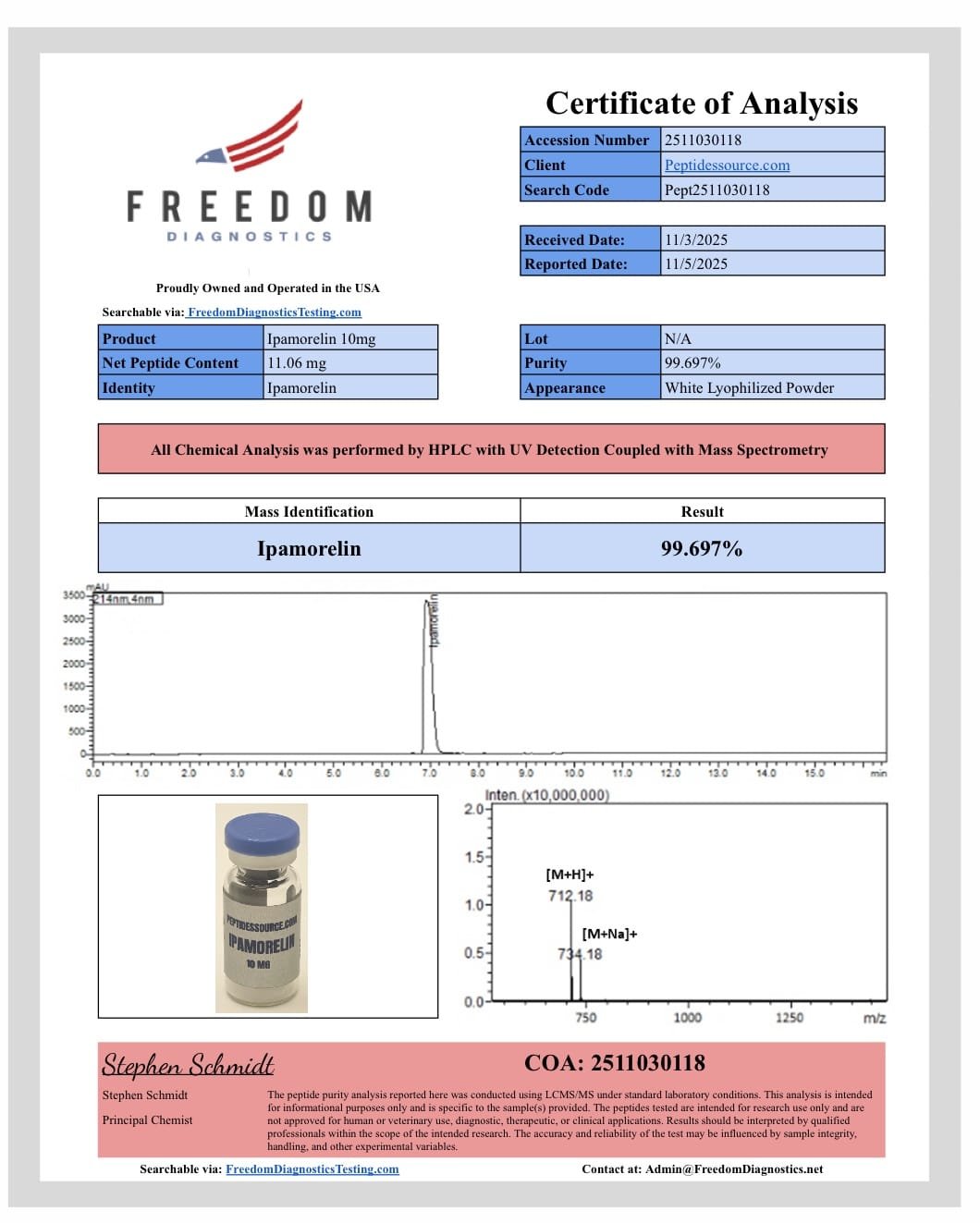
A certificate of analysis for the ipamorelin research peptide is only useful if it is specific to the lot in front of you. For Ipamorelin, confirm that the COA includes:
- Lot number that matches the vial label.
- Identity by mass spectrometry. The observed mass should agree with the expected monoisotopic mass of about 711.39 Da, often reported as the [M+H]+ ion near m/z 712.4 or as a multiply charged ion.
- Purity by reversed-phase HPLC, with the chromatogram, the detection wavelength, and the integrated main-peak percentage. Peptides Source lists greater than 98% purity; the specific lot value should appear on the certificate.
- Net peptide content or assay, where reported, so salt and water content are accounted for.
- Endotoxin result (LAL), where published, with the method and the pass threshold.
- Issuing laboratory, so the report can be independently verified.
In addition, Peptides Source publishes certificates for the ipamorelin research peptide in its COA library; the general approach is explained in COA and testing explained. When a specific lot is not yet digitized, request it before you buy.
Catalog strengths and laboratory handling
Also, Peptides Source lists the ipamorelin research peptide as 5 mg and 10 mg lyophilized vials, plus pre-combined presentations in the Cellular Growth & Signaling category. All material is intended for in-vitro and laboratory procedures only.
General laboratory handling of a lyophilized research peptide — storing the sealed vial cold and protected from light, reconstituting with an appropriate solvent, and aliquoting to avoid freeze-thaw cycles — is covered in our reconstitution guide and storage best practices. This page gives no dosing, no protocol for use in a living subject, and no preparation instructions beyond general bench handling, because Ipamorelin is a research reagent only.
How to evaluate an Ipamorelin supplier
- A lot-matched COA with HPLC and MS, not a single generic certificate reused across batches.
- A named third-party or in-house laboratory that can be contacted.
- Clear, accurate chemical identity (the sequence, formula, and mass above).
- Research-use-only labeling with no human-use or outcome claims.
- Traceable manufacturing. Peptides Source material is made in the USA in a USP 797 sterile facility under the Got Peptides® mark.
Why ipamorelin 5mg vials need lot paperwork
Labs order this analog as a named reagent. Then they must prove what arrived. In fact, the incoming label is only the start of the trail. A lot certificate is that proof. The file should match the label lot. It should also match the stated form and mass. If those lines disagree, the lot is not ready for a careful assay.
Peptides Source publishes lot files in the certificate library. Therefore a buyer can read a file for this analog before placing an order. In addition, the same library lists other lots from the same shop. Ipamorelin 5mg vials still need a lot-matched file, not a generic sheet.
Frequently asked questions
What is Ipamorelin as a research compound?
The ipamorelin research peptide is a synthetic pentapeptide with the sequence Aib-His-D-2-Nal-D-Phe-Lys-NH2 (CAS 170851-70-4). It is studied in laboratory models as an agonist of the ghrelin receptor, GHSR-1a. Peptides Source supplies it as a lyophilized research peptide for in-vitro and laboratory use only. It is not a medicine and is not for human or animal use.
What is the molecular weight and formula of Ipamorelin?
The molecular formula is C38H49N9O5 and the average molecular weight is 711.9 g/mol for the free base, per PubChem CID 9831659. A salt form weighs more because of its counter-ions.
How does Ipamorelin differ from CJC-1295 and Tesamorelin?
They act at different receptors. Ipamorelin is a GHSR-1a (ghrelin-receptor) agonist, while CJC-1295 and Tesamorelin are GHRH-receptor analogues. This is a pharmacological distinction observed in laboratory systems, not a use instruction.
What sizes does Peptides Source supply?
Ipamorelin is listed as 5 mg and 10 mg lyophilized vials, plus pre-combined vials with CJC-1295 or Tesamorelin. Confirm current sizes on the product pages.
How do I verify an Ipamorelin lot?
Match the ipamorelin research peptide vial lot to a certificate of analysis that reports identity by mass spectrometry (expected mass about 711.39 Da) and purity by reversed-phase HPLC, then verify the report with the issuing laboratory.
Is Ipamorelin for human use?
No. It is supplied strictly for in-vitro and laboratory research by qualified professionals and is not for human or animal use or consumption.
Research-use-only statement
All Peptides Source compounds, including the ipamorelin research peptide, are supplied strictly for in-vitro and laboratory research by qualified professionals. They are not drugs, foods, cosmetics, or dietary supplements, and they are not for human or animal use or consumption. Nothing on this page is medical advice, a dosing instruction, or a claim about safety, efficacy, benefits, or outcomes in humans.