
TB-500 peptide is a short synthetic peptide, N-acetyl-Leu-Lys-Lys-Thr-Glu-Thr-Gln (Ac-LKKTETQ; CAS 885340-08-9; C38H68N10O14; 889.0 g/mol), corresponding to an acetylated version of the actin-binding region of the protein thymosin beta-4. Moreover, Peptides Source supplies TB-500 as lyophilized research peptide in 5 mg and 10 mg vials, made in the USA in a USP 797 sterile facility with a certificate of analysis (COA) for every batch. Also, it is supplied for in-vitro and laboratory research only. Therefore, it is not a drug and is not for human or animal use.
However, an important identity point up front: the TB-500 peptide and thymosin beta-4 are not the same molecule. In other words, this page explains the relationship precisely.
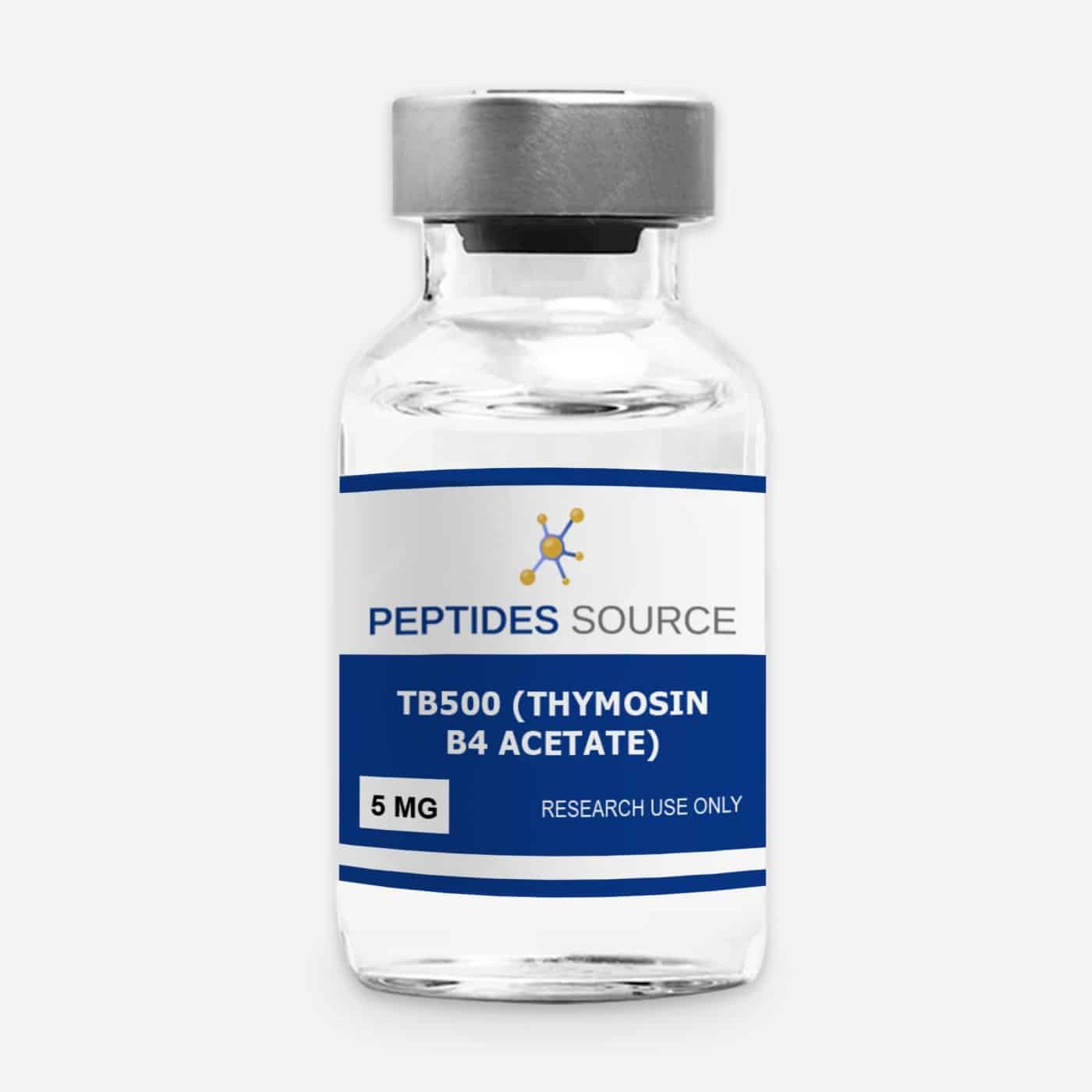
TB-500 peptide at a glance: identity and specifications
| Property | Value |
|---|---|
| Compound name | TB-500 (catalogued as thymosin β4 acetate) |
| CAS number | 885340-08-9 (PubChem CID 62707662) |
| Sequence (one-letter) | Ac-LKKTETQ |
| Sequence (three-letter) | N-acetyl-Leu-Lys-Lys-Thr-Glu-Thr-Gln |
| Length | 7 residues, N-terminal acetyl |
| Molecular formula | C38H68N10O14 |
| Molecular weight | 889.0 g/mol (average, free base, per PubChem) |
| Monoisotopic mass | 888.49 Da |
| Relation | Acetylated fragment of thymosin beta-4 (residues 17-23, LKKTETQ) |
| Physical form | Lyophilized white powder |
| Catalog strengths | 5 mg and 10 mg vials; also in combined vials with BPC-157 |
| Listed purity | Greater than 98% by HPLC (confirm the exact value on the lot COA) |
| Origin | Manufactured in the USA, USP 797 sterile facility |
| Status | Research use only. Not for human or animal use |
Note that the gross powder weight of a lyophilized TB-500 peptide includes counter-ions and residual water; use the net peptide content on the COA when preparing a stock solution.
Structure and relationship to thymosin beta-4
To begin with, thymosin beta-4 (TB4) is a naturally occurring 43-amino-acid polypeptide (approximately 4963 g/mol; PubChem CID 16132341) and the main G-actin-sequestering peptide in mammalian cells (Safer et al., 1991, Journal of Biological Chemistry). Furthermore, within that full protein, a seven-residue motif, (17)LKKTETQ(23), has been identified as the active actin-binding site responsible for actin binding and cell-migration activity in laboratory assays.
In contrast, the TB-500 peptide is the synthetic version of that active region, with an acetylated N-terminus (Ac-LKKTETQ). In short, it is a 7-residue peptide — not the 43-residue protein. As a result, the two share the LKKTETQ motif but differ greatly in size, formula, and mass, so they must not be treated as interchangeable. For example, a doping-control study of equine samples characterized the TB-500 ingredient specifically as N-acetylated LKKTETQ and described its mass-spectrometry behavior (Ho et al., 2012, Journal of Chromatography A).
| Feature | TB-500 | Thymosin beta-4 (full protein) |
|---|---|---|
| Length | 7 residues (Ac-LKKTETQ) | 43 residues |
| Molecular weight | 889.0 g/mol | approx. 4963 g/mol |
| CAS | 885340-08-9 | 77591-33-4 |
| Nature | Synthetic fragment | Naturally occurring polypeptide |
Laboratory-model literature
Specifically, the TB-500 peptide’s LKKTETQ motif has been studied as the essential actin-binding site of thymosin beta-4. Similarly, work using natural thymosin beta-4, proteolytic fragments, and synthetic peptides reported that this seven-amino-acid motif is required for the angiogenic activity observed in endothelial-cell migration and vessel-sprouting assays, with the peptide and full protein showing comparable activity at nanomolar concentrations in those systems (Philp et al., 2003, FASEB Journal). In addition, thymosin beta-4 itself is described as a G-actin-sequestering peptide in cell biology (Cassimeris et al., 1992, Journal of Cell Biology; Huff et al., 2001, International Journal of Biochemistry & Cell Biology).
In short, these are findings in defined cell and animal experimental systems. In other words, they describe actin biology and assay outcomes studied in the laboratory. Consequently, they do not establish any effect in people, and nothing here should be read as a human claim about recovery, tissue repair, or any other outcome.
Comparison with BPC-157
Notably, the TB-500 peptide is frequently paired with BPC-157, but they are different peptides: BPC-157 is a 15-residue synthetic sequence, while TB-500 is the 7-residue acetylated thymosin beta-4 fragment. In other words, they have separate sequences and separate literature. For instance, pre-combined vials exist, such as the BPC-157 / TB-500 combo 10 mg and a BPC 10 mg / TB 10 mg presentation, and TB-500 appears in the multi-component Klow blend. In short, a combined vial is a documented preparation of its components, not a separately characterized pharmacology. For this reason, see our BPC-157 vs TB-500 research comparison.
Analytical verification: what a TB-500 COA should show
Therefore, for the TB-500 peptide, confirm that the certificate is specific to your lot and includes:
- Lot number matching the vial label.
- Identity by mass spectrometry. The observed mass should agree with the expected monoisotopic mass of about 888.49 Da, often reported as the [M+H]+ ion near m/z 889.5. In addition, this also distinguishes the 7-residue fragment from the much larger full-length protein.
- Purity by reversed-phase HPLC, with chromatogram, detection wavelength, and main-peak percentage. Peptides Source lists greater than 98% purity; the lot value should be on the certificate.
- Net peptide content or assay, where reported.
- Endotoxin (LAL) result, where published.
- Issuing laboratory, so the report can be verified.
Additionally, certificates for the TB-500 peptide are published in the COA library; the approach is described in COA and testing explained.
Catalog strengths and laboratory handling
First, Peptides Source lists the TB-500 peptide as 5 mg and 10 mg lyophilized vials, plus combined vials with BPC-157, in the Extracellular Matrix & Repair category. General handling of a lyophilized research peptide — cold, light-protected storage, reconstitution with an appropriate solvent, and aliquoting to limit freeze-thaw — is covered in our reconstitution guide and storage best practices. Finally, no dosing and no instructions for use in a living subject are given, because TB-500 is a research reagent only.
How to evaluate a research-peptide supplier
- A lot-matched COA with HPLC and MS that confirms the 7-residue fragment identity.
- A named laboratory that can confirm the report.
- Accurate chemical identity (the Ac-LKKTETQ sequence, formula, and mass above), and a clear statement of the thymosin beta-4 relationship.
- Research-use-only labeling with no human-use or outcome claims.
- Traceable USA manufacturing under the Got Peptides® mark.
Frequently asked questions
What is TB-500 as a research peptide?
The TB-500 peptide consists of seven residues, N-acetyl-LKKTETQ (CAS 885340-08-9), corresponding to the acetylated actin-binding region of thymosin beta-4. In addition, Peptides Source supplies it as a lyophilized research compound for in-vitro and laboratory use only. However, it is not a medicine and is not for human or animal use.
Is TB-500 the same as thymosin beta-4?
No. Specifically, thymosin beta-4 is a 43-residue natural polypeptide (approx. 4963 g/mol). In contrast, TB-500 is a 7-residue acetylated fragment (Ac-LKKTETQ, 889.0 g/mol) corresponding to its actin-binding motif. Thus, they share that motif but are different molecules.
What is the molecular weight and formula of TB-500?
The molecular formula is C38H68N10O14 and the average molecular weight is 889.0 g/mol for the free base, per PubChem CID 62707662. However, a salt form weighs more.
How is TB-500 different from BPC-157?
In short, they are different peptides with separate sequences and literature. For example, TB-500 is a 7-residue thymosin beta-4 fragment; BPC-157 is a 15-residue synthetic peptide. Therefore, they are not interchangeable.
How do I verify a TB-500 lot?
Match the TB-500 peptide vial lot to a certificate of analysis reporting identity by mass spectrometry (expected mass about 888.49 Da) and purity by reversed-phase HPLC, then verify the report with the issuing laboratory.
Is TB-500 for human use?
No. Instead, it is supplied strictly for in-vitro and laboratory research by qualified professionals and is not for human or animal use or consumption.
Research-use-only statement
All Peptides Source compounds, including the TB-500 peptide (thymosin β4 acetate), are supplied strictly for in-vitro and laboratory research by qualified professionals. Accordingly, they are not drugs, foods, cosmetics, or dietary supplements, and they are not for human or animal use or consumption. Likewise, nothing on this page is medical advice or a claim about tissue repair, recovery, safety, efficacy, or other outcomes in humans.